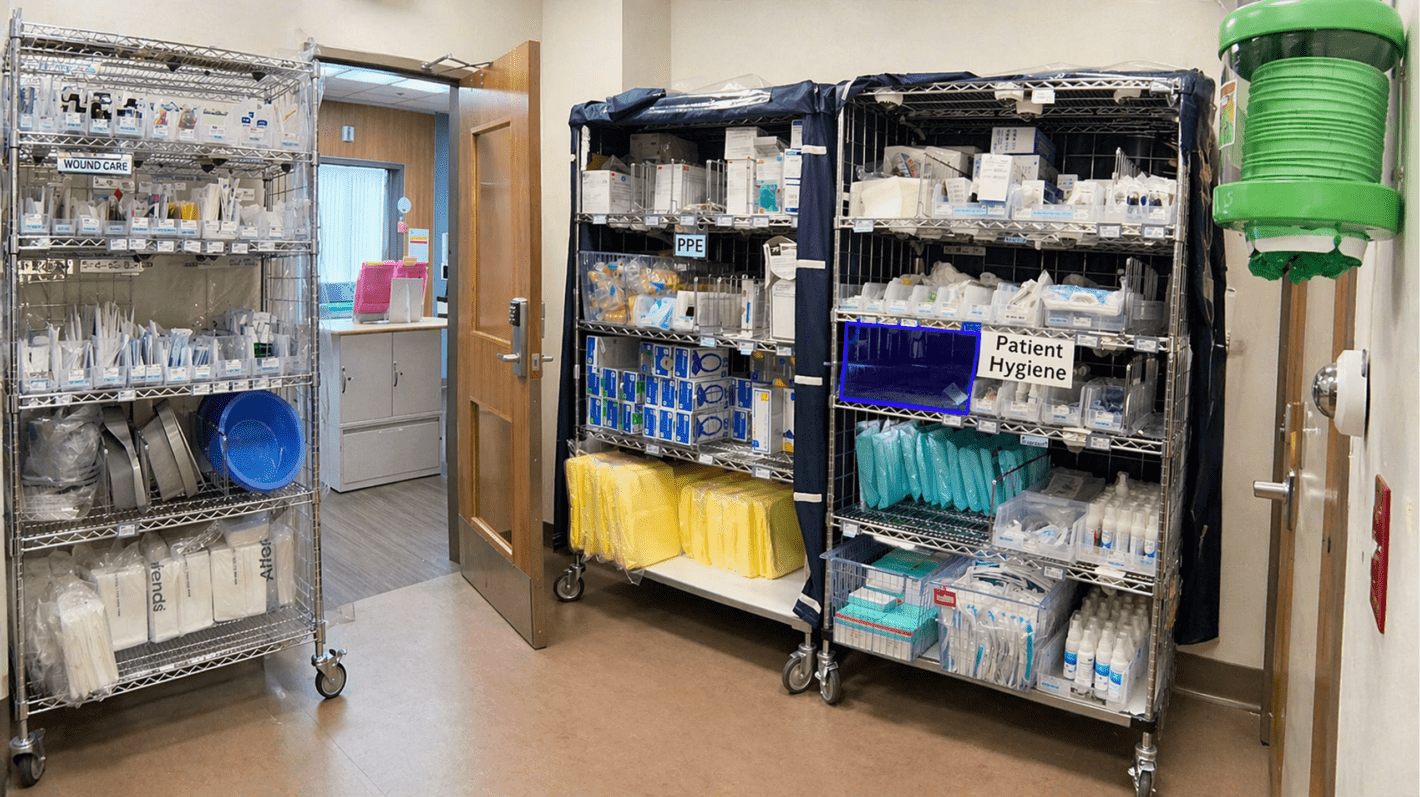


Hospital inventory management systems play a critical role in ensuring that the right supplies are available at the point of care. From surgical supplies and implants to pharmaceuticals and consumables, healthcare organizations depend on accurate inventory visibility to maintain clinical readiness, reduce waste, and control costs.
Yet many hospitals still rely on a combination of manual counting, barcode scanning, and RFID technologies to manage inventory. While these systems can improve record-keeping compared to paper-based processes, they often fall short of delivering the real-time operational visibility modern healthcare systems require.
As healthcare organizations pursue digital transformation and operational efficiency, a new generation of AI-powered hospital inventory management systems is emerging. Computer vision platforms such as Chooch use AI-enabled cameras and visual intelligence to automate inventory monitoring, helping hospitals reduce stockouts, lower inventory carrying costs, and improve supply chain resilience.
The Evolution of Hospital Inventory Management Systems
Most hospital inventory management systems fall into four categories:
- Manual inventory management
- Barcode-based inventory systems
- RFID inventory tracking systems
- AI vision inventory management systems
Each approach offers different levels of automation, accuracy, and operational intelligence.
Manual Hospital Inventory Management Systems
Manual inventory management remains surprisingly common across healthcare facilities. Staff perform cycle counts, visually inspect shelves, record quantities, and enter information into inventory systems.
While simple to implement, manual processes create several challenges:
- Labor-intensive inventory audits
- Human counting errors
- Delayed replenishment decisions
- Limited visibility between inventory checks
- Increased risk of stockouts and overstocking
- Valuable clinical and supply chain staff time diverted from higher-value activities
Healthcare professionals are trained to care for patients, not spend hours counting supplies. As inventory volumes increase across hospitals, manual processes become increasingly difficult to sustain.
Barcode Inventory Management Systems
Barcode technology represented a significant advancement over manual counting. Products are assigned unique identifiers that can be scanned during receiving, stocking, and consumption workflows.
Benefits of barcode systems include:
- Improved inventory record accuracy
- Lower technology costs
- Established integration with ERP and supply chain systems
- Familiar workflows for healthcare organizations
However, barcode systems still depend heavily on human participation.
Every inventory movement requires someone to scan an item. If a product is removed without being scanned, inventory records immediately become inaccurate. In busy hospital environments, compliance with scanning procedures often varies across departments and shifts.
Barcode systems answer the question, “What was scanned?” They do not automatically answer, “What is physically on the shelf right now?”
RFID Inventory Management Systems
RFID inventory management systems were developed to reduce some of the limitations of barcode-based approaches.
RFID tags can be automatically detected without requiring direct line-of-sight scanning. Hospitals often deploy RFID technology for high-value assets, specialty devices, and selected inventory categories.
Advantages include:
- Reduced manual scanning requirements
- Faster inventory identification
- Improved asset tracking
- Automated location awareness for tagged items
Despite these advantages, RFID systems face several limitations in healthcare inventory environments.
RFID Requires Tagged Inventory
Every tracked item must be tagged. This introduces additional cost, implementation complexity, and ongoing maintenance requirements.
For large healthcare systems managing thousands of SKUs across hundreds of supply rooms, maintaining RFID coverage can become operationally challenging.
RFID Cannot See Shelf Conditions
RFID systems identify tagged items but do not provide visual awareness of storage conditions.
They cannot easily determine:
- Shelf fullness levels
- Product presentation issues
- Incorrect product placement
- Inventory organization problems
- Visual confirmation of stock conditions
RFID Still Creates Visibility Gaps
RFID systems generate location-based data, but they often lack the contextual understanding required to support comprehensive inventory optimization and autonomous replenishment workflows.
Hospitals may know an item exists somewhere within a tracked area but still struggle to understand actual inventory conditions across multiple departments in real time.
Why Traditional Hospital Inventory Management Systems Fall Short?
Whether manual, barcode-based, or RFID-enabled, traditional hospital inventory management systems share a common limitation:
They depend on people to create inventory visibility.
Inventory records are only as accurate as the last count, scan, or tag interaction.
This creates operational blind spots that can result in:
- Stockouts of critical supplies
- Excess inventory and wasted capital
- Expired products
- Emergency purchasing costs
- Delayed procedures
- Reduced supply chain efficiency
In today’s healthcare environment, periodic visibility is no longer enough.
Hospitals increasingly require continuous inventory awareness.
AI Vision Hospital Inventory Management Systems
AI vision inventory management systems represent a fundamentally different approach.
Instead of relying on manual counts, barcode scans, or RFID tag reads, AI-powered cameras continuously monitor inventory locations and use computer vision models to identify products, track quantities, and detect inventory changes automatically.
The result is a digital layer of operational intelligence over the physical supply environment.
How AI Vision Works
AI-powered cameras monitor supply rooms, shelves, bins, carts, and storage locations.
Computer vision models analyze visual data to determine:
- Product identity
- Inventory counts
- Shelf fullness levels
- Consumption patterns
- Replenishment requirements
- Inventory anomalies
This creates a continuously updated inventory picture without requiring staff to perform manual counts or routine scanning activities.
Why Chooch Delivers Better Inventory Visibility?
Chooch transforms hospital supply rooms into intelligent, self-monitoring environments that continuously track inventory conditions and support operational decision-making.
Unlike barcode and RFID systems, Chooch does not require staff to scan every item movement or maintain thousands of inventory tags.
The platform uses AI-powered computer vision to generate inventory intelligence directly from visual observations of supply environments.
This enables:
- Continuous inventory visibility
- Automated inventory counting
- Cross-room inventory awareness
- Consumption analytics
- Demand forecasting
- Replenishment intelligence
- Expiration and recall monitoring
By creating real-time visibility into inventory conditions, hospitals can move from reactive inventory management to proactive inventory optimization.
Clinical and Financial Benefits of AI-Powered Inventory Management
Healthcare organizations adopting AI vision inventory management systems can achieve improvements across multiple operational areas.
Improved Clinical Readiness
When supplies are visible and available where they are needed, care teams spend less time searching for products and more time focused on patient care.
Reduced Stockouts
Continuous monitoring helps identify inventory risks before shortages occur.
Lower Inventory Costs
Hospitals can reduce excess inventory while maintaining appropriate service levels.
Reduced Waste
Better visibility into inventory levels and expiration timelines helps minimize product waste.
Greater Supply Chain Efficiency
Supply chain teams can focus on exceptions and optimization opportunities rather than manual inventory audits.
The Future of Hospital Inventory Management Systems
Healthcare supply chains are moving toward autonomous operations powered by AI, computer vision, and intelligent automation.
Manual counting, barcode scanning, and RFID technologies will continue to play important roles in specific workflows. However, they were not designed to provide the continuous operational awareness required by modern healthcare systems.
AI vision platforms such as Chooch provide a more comprehensive approach by transforming inventory management from a periodic, labor-intensive process into a continuously monitored, intelligence-driven operation.
For healthcare organizations seeking to improve inventory accuracy, reduce stockouts, lower costs, and support clinical readiness, AI-powered hospital inventory management systems represent the next stage in supply chain modernization.