
Hospital Inventory Management Software with Vision AI.
How Chooch works, from cameras on shelves to POs in your ERP.
A screen-by-screen look at Chooch running in live hospital environments deployed across hundreds of supply rooms, monitoring hundreds of millions of dollars of medical supplies per health system. Here is what the software actually does.
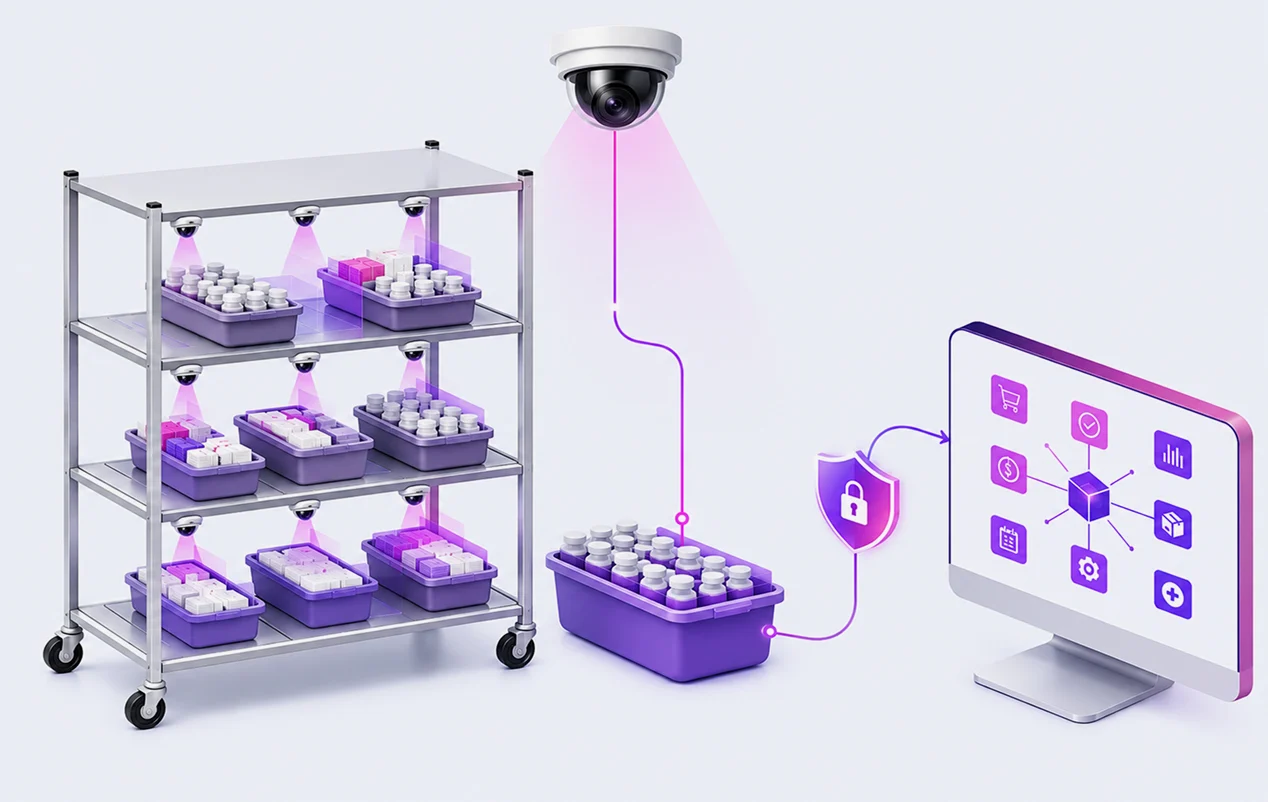
Capture
Cameras watch the shelf continuously
Detect
Vision AI identifies each product
Count
On-hand levels with real-time updates
Reorder
Orders fire into the ERP, touchless
Forecast
Consumption data forcasts demand
One screen for every shelf in each building across a hospital system.
The dashboard consolidates inventory health across every monitored location current stock, consumption trends, pending reorders, and exceptions so supply chain teams manage the whole facility without walking into a single storage room.
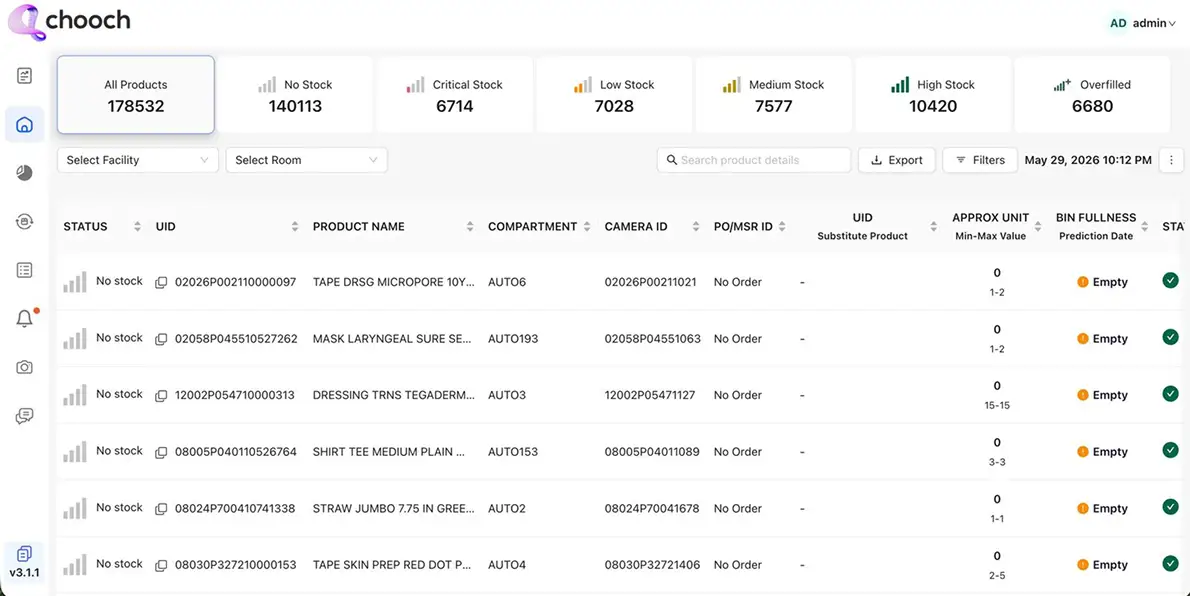
Inventory Control Tower system-wide inventory at a glance

Live inventory position
Current count and percentage-full status for every tracked SKU across PAR rooms, ORs, Cath Labs, SPD, and every other monitored department.
Consumption velocity
How fast each product is being used, by department and time of day so reorder timing follows real demand instead of a calendar and best-effort manual counts.
Alert queue
Items approaching their reorder threshold surface automatically, ranked by urgency and lead time, so staff act on exceptions rather than auditing everything.
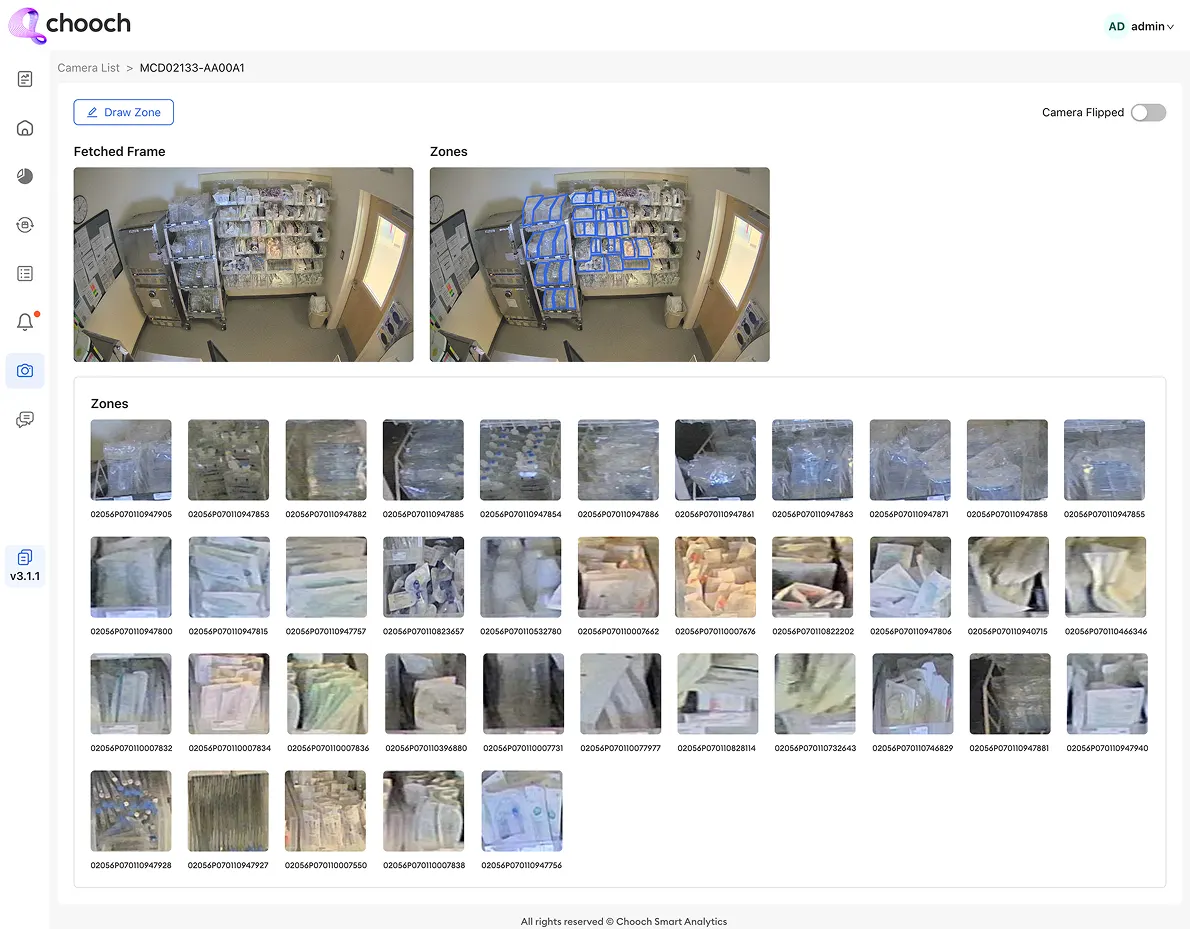
Camera snapshot monitored zones
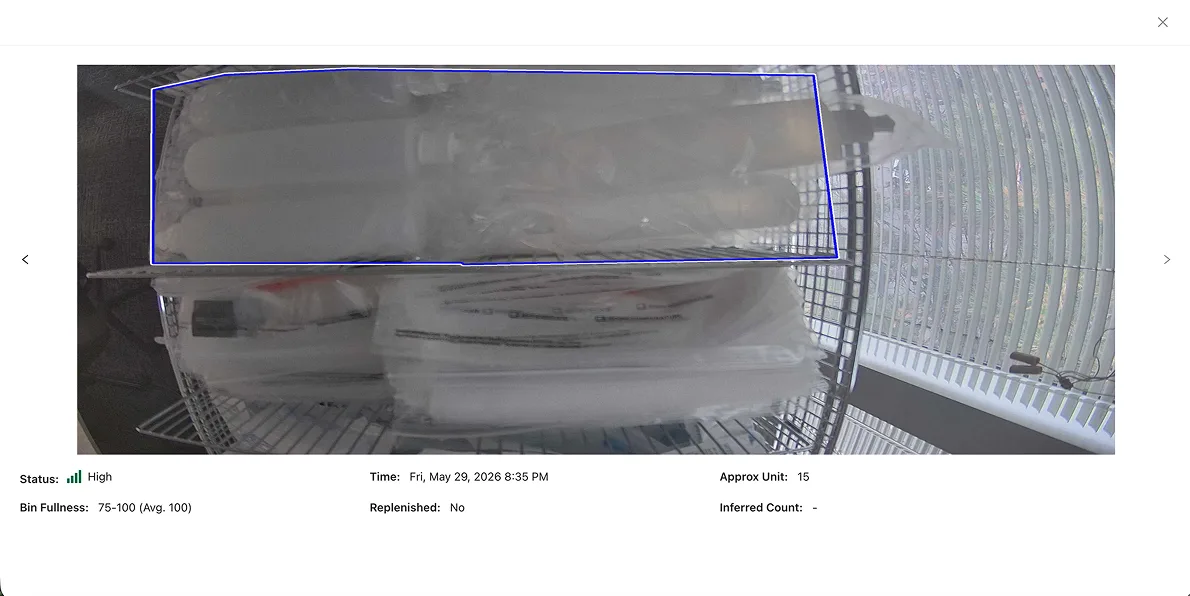
Individual zone detection within the snapshot
Detection happens on the shelf not in a count sheet.
Secure AI camera sensors mount inside or beside existing shelves, wire racks, bins, and rolling carts. No shelving modifications. Each camera captures a continuous feed that becomes the ground-truth data behind every real-time count.
Non-invasive installation
Cameras fit existing shelving or wall infrastructure. Supply layouts, labels, and clinical workflows stay exactly as they are today.
Multi-SKU detection
The vision-language model identifies individual products, their units of measure, and current plus consumption data — in real time.
Privacy protected by design
Faces, staff credentials, and identifying details are blurred on-device before any data leaves it. Architecture is ISO 9001 certified and aligned to ISO 27001 and SOC 2.
Below the reorder point, the order is already moving.
When a product drops below its reorder point, Chooch drafts a replenishment order and pushes it straight into the hospital’s ERP with no human having to notice, log, or key it in.
Threshold configuration
Minimum, target, and maximum stock levels are set per SKU during onboarding, then tuned over time as the system learns actual consumption patterns.
Touchless order generation
Purchase orders are drafted and submitted to the supplier automatically. Procurement reviews a queue report instead of raising each order by hand.
ERP sync
Orders, receipts, and inventory adjustments reflect in the ERP in real time, keeping financial and supply chain records aligned without manual data entry.
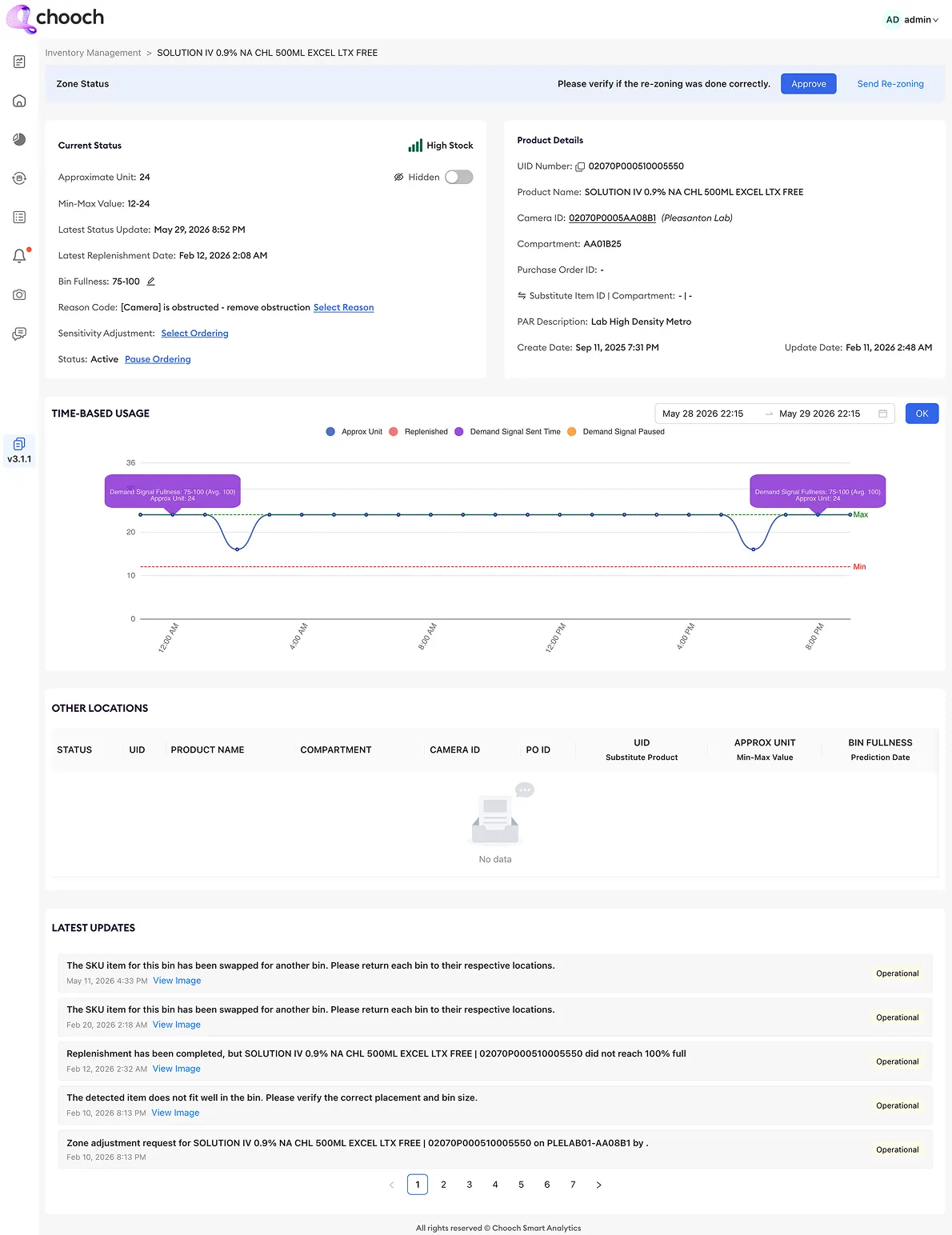
Product detail counts, thresholds, and order activity for a single SKU
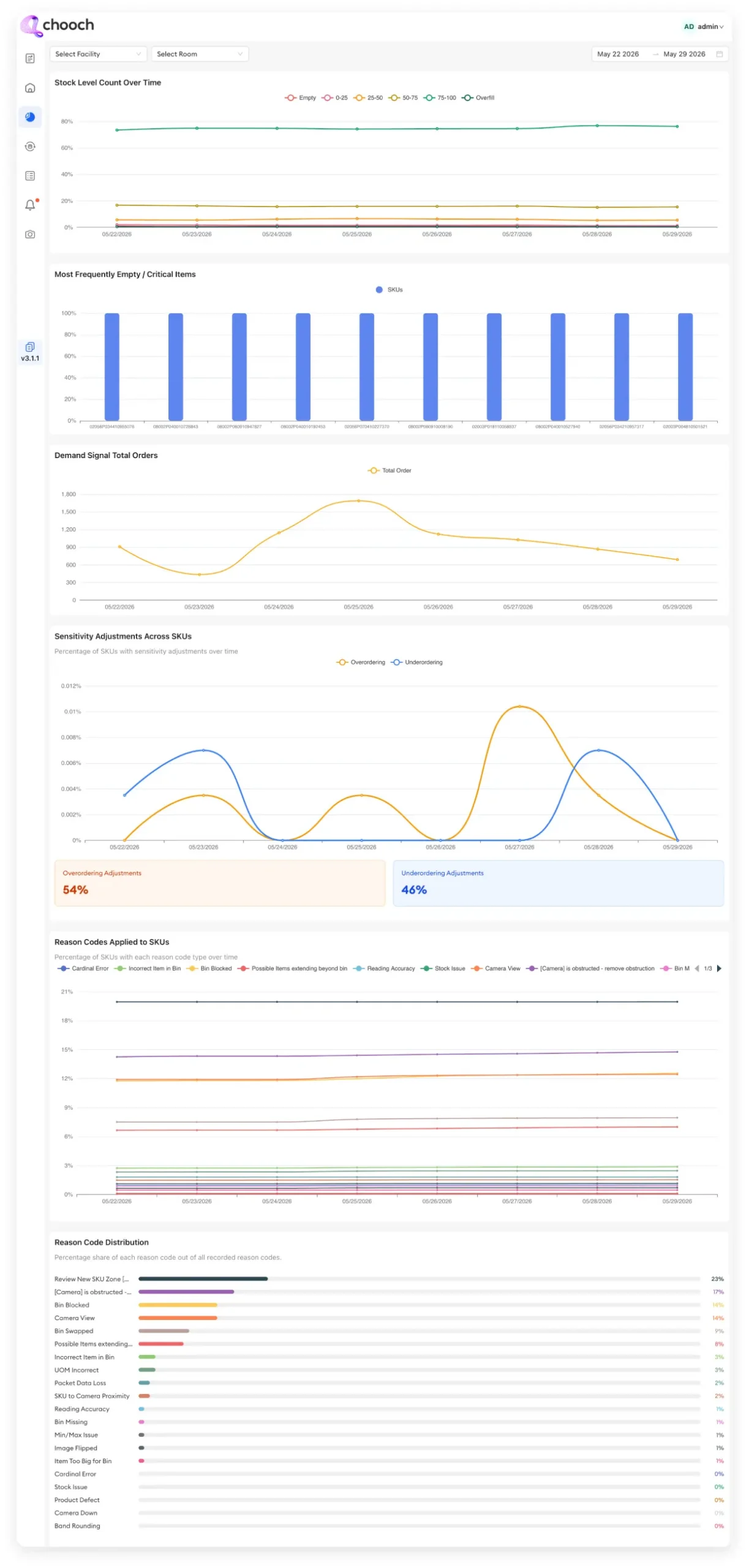
Reporting — consumption, turns, and demand signals
Every SKU gets its own live consumption model.
Beyond counts, Chooch builds a real-time consumption model for every product in every location tracking usage by day, shift, department, and procedure type so ordering becomes predictive rather than reactive.
Run-rate projections
Projected depletion times are calculated from recent usage, flagging items that will run out before the next scheduled delivery window.
Anomaly detection
Unusual spikes a rapidly depleting item ahead of a large procedure, for example are caught and factored into reorder logic automatically.
Inventory turns reporting
Slow-moving SKUs tying up capital or approaching expiration and recalls surface in regular reporting, enabling proactive substitution before they become waste.
The system tracks identity not just quantity.
Because Chooch recognizes what each product is, it can flag items nearing expiration, surface anything under active recall, and help keep recalled or expired supplies out of patient care.

Waste caught early
Products nearing expiration surface in the dashboard before they become waste giving staff time to prioritize use, apply an approved substitute, or initiate a return.

Instant visual identification
When a recall is entered, Chooch visually identifies every affected item across all monitored locations immediately, with audio notifications no manual labeling or audit required.

Automatic audit trail
Every recall response is logged automatically, creating an audit trail ready for regulatory and accreditation review.
Four things to know before you start.
01
Think big, start small, scale fast
Begin with a few inventory rooms in any department. Phase-one ROI is typically measurable within the first two quarters through rapid inventory optimization and efficiency gains.
02
ERP readiness
Chooch integrates via a standard secure API to auto-reorder. No custom development is required to connect to your materials management system.
03
Clinical change management
No workflow changes are asked of nursing or clinical staff. The system fits existing clinician workflows, minimizing training and change management.
04
Compliance verification
Built for healthcare and carrying the certifications your IT, security, and risk teams expect designed to support safe, affordable care.
What Supply Chain, IT and Clinical Operations Professionals are Asking About Autonomous AI
Choosing a new hospital SCM software solution with AI can raise a lot of questions.
How does Chooch identify and count items?
Chooch uses advanced AI-powered computer vision to monitor inventory in real time without requiring manual counting or routine barcode scanning. AI-enabled cameras capture scheduled images of storage locations, while Chooch’s computer vision, Large Vision Models (LVMs), and ensemble AI models analyze each image to recognize inventory bins, shelves, storage locations, and product packaging. The result is continuous, real-time inventory visibility with minimal manual intervention. The system automatically triggers replenishment workflows when predefined inventory thresholds are reached, reducing manual inventory checks, minimizing stockouts, and improving inventory accuracy.
What hardware is required — do storage rooms need new cameras, servers, or can use existing infrastructure?
A typical Chooch deployment includes AI-enabled PoE cameras, an on-premises Edge Server (or customer-provided virtual machine), managed PoE network switches, and standard CAT5e/CAT6 Ethernet cabling. Optional wireless connectivity is available where Ethernet is not practical.
Chooch is designed to work within existing hospital IT environments whenever possible. Existing ERP, supply chain, and network infrastructure can remain in place, allowing organizations to modernize inventory operations without replacing their core systems.
Is Chooch cloud-based, and where is data processed and stored?
Chooch operates as a hybrid edge-cloud platform that combines on-premises edge infrastructure with Microsoft Azure cloud services. Inventory images are securely captured on-site, processed through dedicated Azure Kubernetes Service (AKS) inference clusters, and stored within isolated customer environments. Inventory snapshots are stored in Azure Blob Storage, while operational metadata and analytics are maintained in dedicated PostgreSQL databases. Each customer’s deployment is logically isolated within its own Azure Resource Group and Virtual Network to ensure data separation and security.
How do alerts work — low stock, expirations, recalls, or misplaced items?
Chooch continuously monitors inventory conditions and automatically generates operational alerts when predefined conditions are detected. Current capabilities include identifying empty bins, partial inventory, continuous excess inventory, replenishment requirements, and other inventory anomalies. AI-generated demand signals and replenishment recommendations are delivered through the operational dashboard and can be integrated with downstream ERP and supply chain systems to automate inventory workflows.
How durable are the cameras, and what happens if one is damaged?
Chooch deploys enterprise-grade PoE cameras designed for continuous healthcare inventory monitoring. The platform continuously monitors the operational health of deployed devices through centralized device management. If a camera experiences an issue or becomes unavailable, device monitoring systems generate alerts, enabling administrators or Chooch to support teams to quickly identify, troubleshoot, and restore service.
What is the camera-to-SKU ratio? What is the percentage of accuracy?
Each camera is positioned to monitor a defined inventory storage area, such as shelves, racks, or Kanban locations. The number of SKUs monitored by a single camera depends on factors such as room layout, shelving configuration, viewing angle, product density, and operational requirements. During implementation, Chooch designs the deployment to provide optimal inventory visibility for each customer environment. Chooch’s AI models are designed to provide highly accurate inventory monitoring by combining advanced computer vision, transformer-based AI models, OCR, and model performance is continuously refined through configuration, sensitivity tuning, and customer-specific optimization to align with operational workflow.
How long does implementation take, from installation to going live?
The team at Chooch can set up a room in less than two weeks, but often regulations and approvals do take more time. However, the team has experience navigating these issues and can quickly execute on ERP integrations, camera installs, and getting the system online.
Innovation Partners


See how Chooch can manage your stockrooms.
In 30 minutes, see Chooch track inventory, detect shortages, and trigger replenishment on the same screens you just toured.
Or call us: (800) 997-0115