
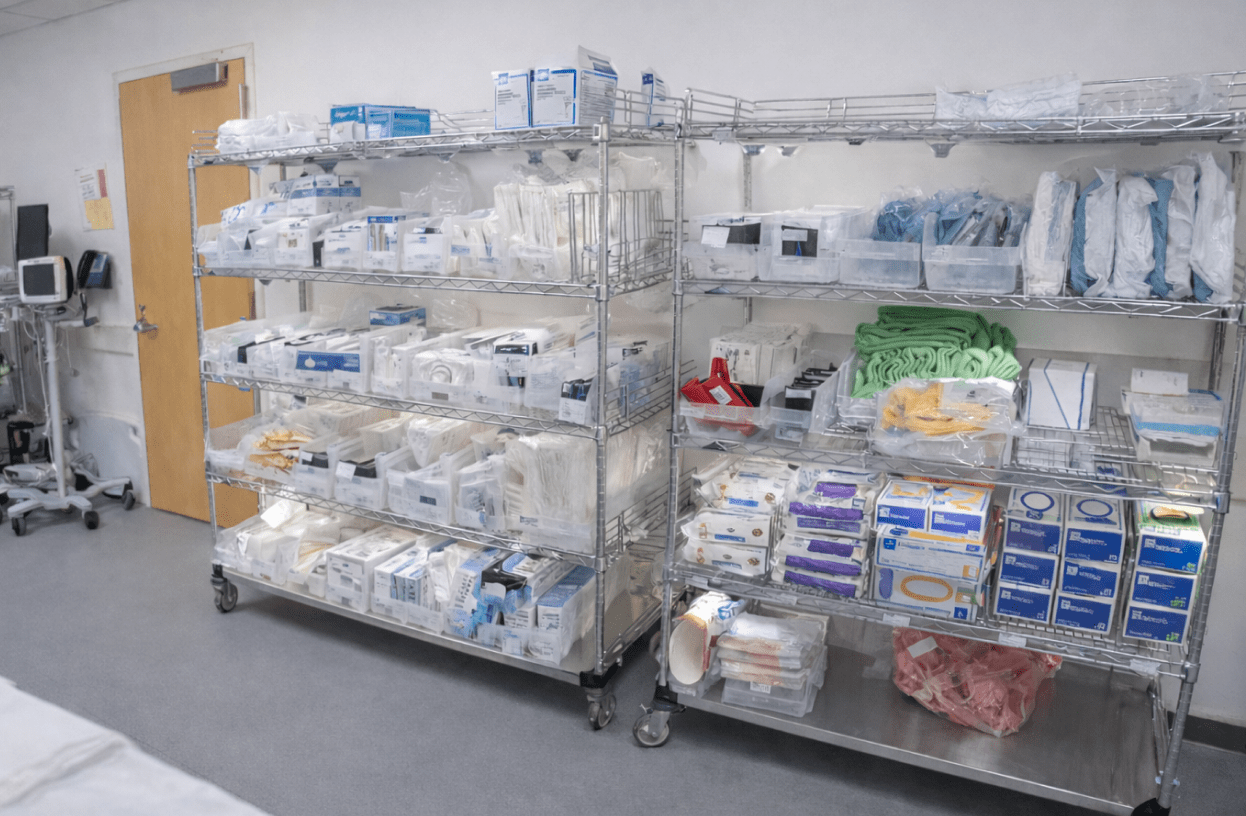
Hospital Inventory
Management System. Automated.
Inventory inside supply rooms updates as supplies are removed or restocked, so on-hand levels stay accurate and replenishment is based on what is actually there.

Innovation Partners


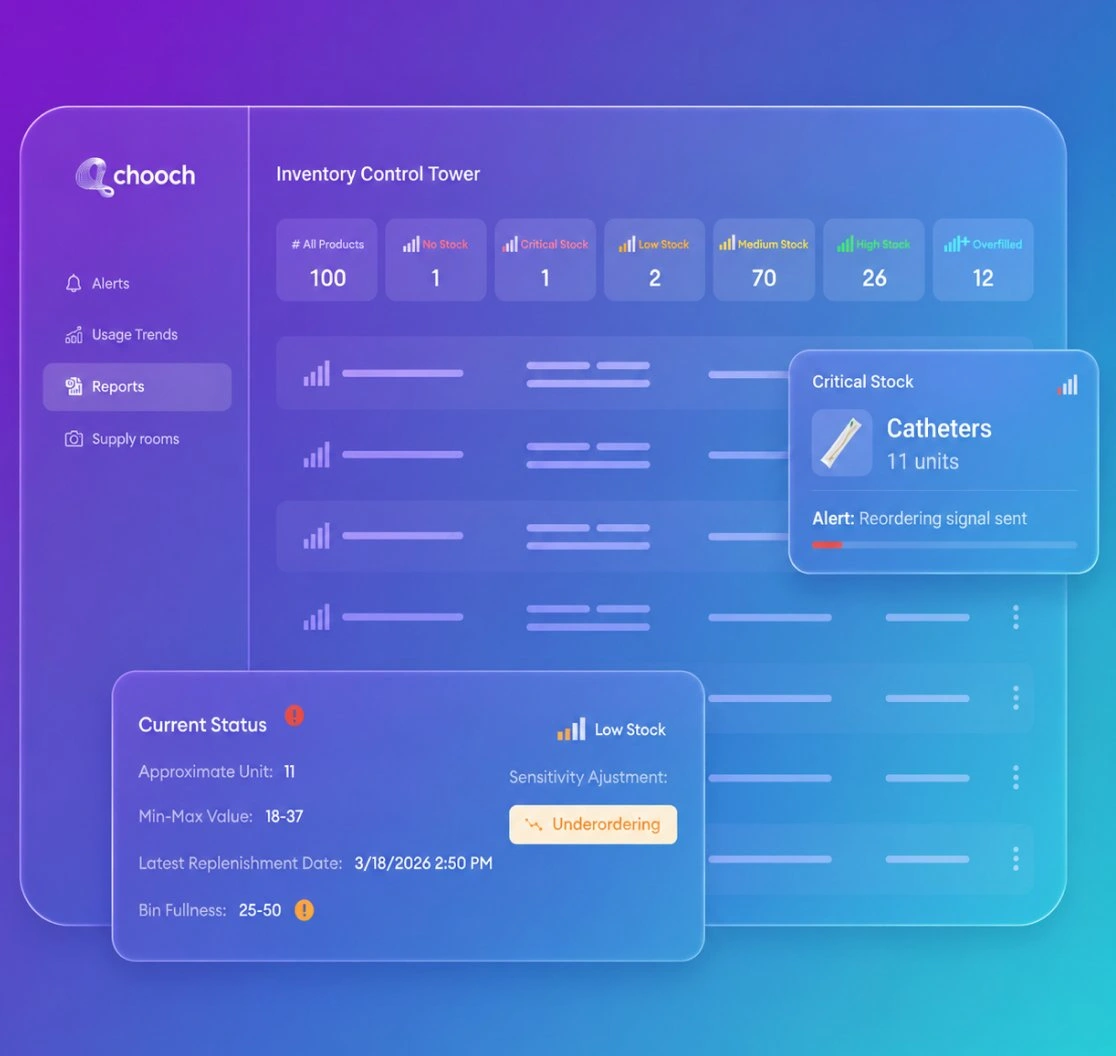
The Inventory Control Tower Gives Supply Chain Insights.
In Real Time, and Over Time.
Inventory across supply rooms appears in a single operational view. Teams can review on-hand inventory, PAR status, and replenishment activity by item and location.
- On-hand inventory by item and location
- Inventory status relative to PAR or min/max levels
- Replenishment and depletion activity over time
- Supply rooms approaching stockouts or overstock conditions
Inventory is known. AI Counts and Analyzes Supplies On Hand.
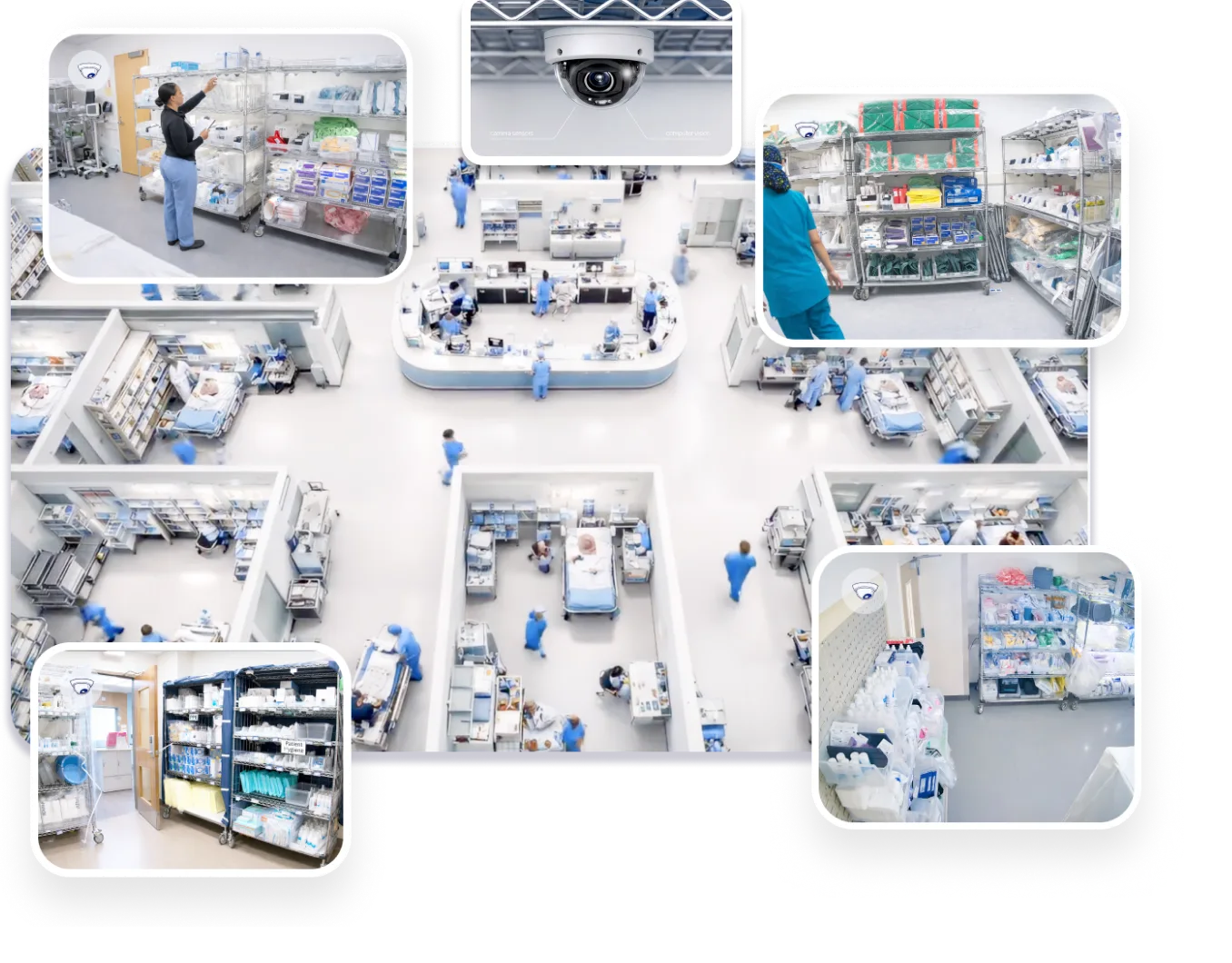
Fixed cameras monitor shelves and bins inside configured supply rooms, supply closets, and PAR locations.
When supplies are removed or restocked, the change at that shelf or bin location is detected automatically. Inventory activity is captured as it happens rather than during periodic manual counts.
Inventory Location
- Supply rooms
- PAR locations
- Supply closets
Shelf-level Monitoring
- Shelves
- Bins
- Racks
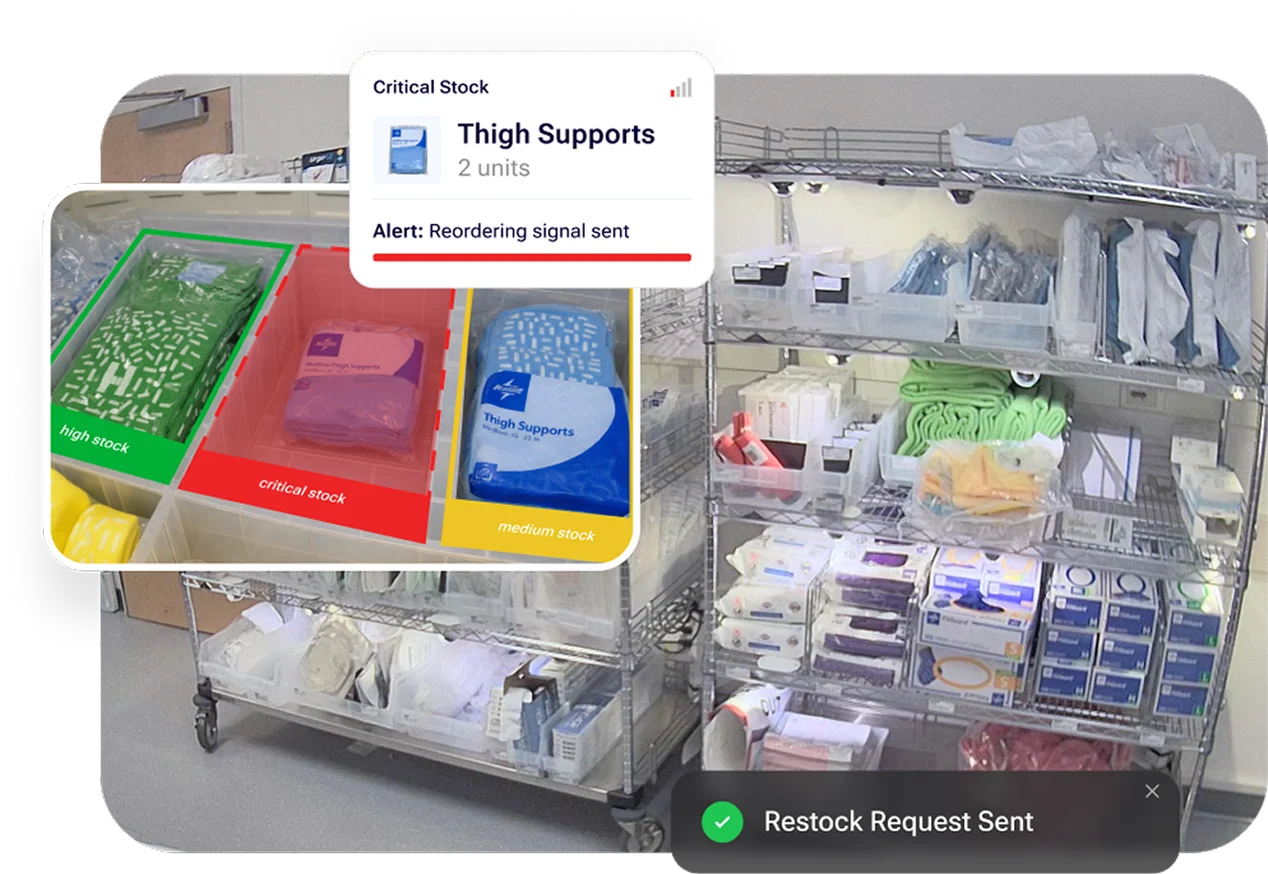
Restock Orders Are Prepared
When Replenishment Alerts
Trigger at PAR levels.
When inventory drops below PAR or min/max levels at a shelf or bin location, a replenishment alert is generated.

No barcode scanning

No RFID tags

No manual counts

No guesswork
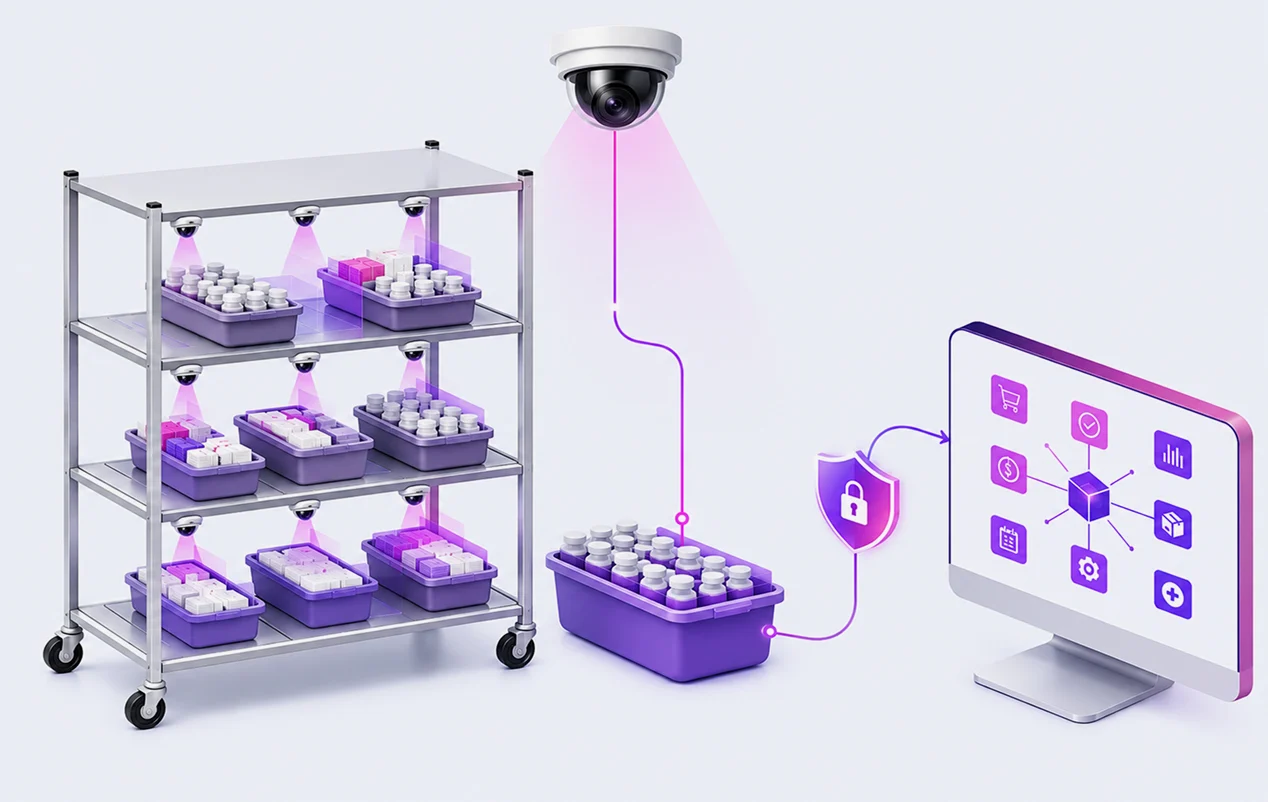
Information Is Optimized in ERP and MMIS Systems.
Observed inventory data from supply rooms feeds into existing ERP and MMIS systems.
Purchasing, approvals, and financial records continue to operate within those systems.
From Hospital Teams* Managing Over $1B of Medical Supplies.

We’re no longer walking supply rooms or counting inventory to figure out what’s missing.
When I come in to work, I know the supplies I need are there and easy to find.
We couldn’t trust inventory between cycle counts. Now we know what’s on the shelf.
* we will share hospital client list with you on a walkthrough.
Chooch Protects Data and Operations With Enterprise-Grade Standards.

ISO 27001 certified
a globally recognized standard for managing information security


NIST 800-171 & DFARS aligned
meets defense industry cybersecurity standards

SOC 2 Type II
industry standard indepependant security audit completed


ISO 9001:2015 Certified
commitment to quality, continual improvement, and customer satisfaction
Operational Benefits of
Accurate Inventory

Stockouts decrease
Low inventory conditions are detected earlier

Cycle counts ends
Staff no longer need to walk supply rooms to count bins

Inventory is aligned
System records match what’s on the shelf.

Overstock is visible
Excess inventory becomes visible before it accumulates
What Supply Chain, IT and Clinical Operations Professionals are Asking About Autonomous AI
Choosing a new hospital SCM software solution with AI can raise a lot of questions.
Does Chooch replace an existing PAR or ERP system, or integrate with it?
The Chooch Autonomous AI Inventory solution integrates seamlessly with existing legacy ERP or supply chain systems, enabling a modern, automated approach to inventory management without requiring replacement of back-end infrastructure. The implementation introduces secure connectivity to the MSFT dedicated cloud-hosted platform, deployment of AI-enabled cameras, and configuration of monitoring, security, and administrative controls.
Is Chooch compliant with data privacy and security regulations?
Security is built into every layer of the Chooch platform. Chooch maintains an ISO/IEC 27001-certified Information Security Management System (ISMS) and aligns its operational security practices with HIPAA Security Rule considerations, NIST cybersecurity frameworks, and additional enterprise security controls. The platform supports encryption both in transit (TLS 1.2+) and at rest (AES-256), Single Sign-On (SSO), Multi-Factor Authentication (MFA), Role-Based Access Control (RBAC), customer environment isolation, and comprehensive audit logging. The platform is designed for healthcare inventory management and is intended to operate without processing protected patient information (PHI) or personally identifiable information (PII) during inventory monitoring workflows.
Does Chooch use facial recognition, or capture identifiable people?
Chooch is designed to monitor inventory—not people. The platform focuses on shelves, racks, bins, and storage locations to determine inventory status. Additionally, Chooch incorporates DNAT 2.0 (Dynamic Neural Anonymization Technology), which automatically blurs individuals captured in images before processing to align with healthcare privacy standards. The platform is not intended to perform facial recognition or identify individuals.
What is the cost and pricing for hospitals?
Chooch solutions are tailored to each healthcare organization. Pricing depends on several factors, including the number of inventory locations, cameras deployed, integration requirements, implementation scope, and ongoing requirements. Because every healthcare environment is unique, Chooch works with customers to develop a solution and pricing model that aligns with their operational goals and existing infrastructure.
What kind of results or ROI have organizations seen from the Chooch?
Healthcare organizations deploying Chooch Autonomous AI have achieved measurable improvements in inventory management, operational efficiency, and supply chain performance.
Phase 1 Benefits (0–6 months):
- Real-time inventory visibility across supply locations.
- Automated inventory counting and hands-free replenishment workflows.
- Up to 40% inventory optimization.
- Up to 50% improvement in staff productivity by reducing manual inventory counting.
- Up to 95% reduction in stockouts.
Phase 2 Benefits (6–18 months):
- Fewer rush orders and overtime.
- Approximately 15% reduction in inventory waste and expirations.
- Reduced replenishment lead times (for example, from 7 days to as little as 3 days, depending on operational processes).
- Improved weekend ordering and inventory planning.
- Up to 25% optimization of storage space through better inventory utilization.
The actual ROI varies based on each organization’s inventory processes, deployment scope, and operational environment. Chooch works closely with customers to establish baseline metrics and quantify improvements throughout the deployment.
What Is a Hospital Inventory Management System?
A hospital inventory management system is the software, and often the hardware, that tracks medical supplies across supply rooms and storage locations. It records what is on hand, monitors how quickly items are used, and triggers replenishment before stock runs short. Systems range from manual counts and spreadsheets to barcode, RFID, and Vision AI, and they differ mainly in how they capture what is used. Chooch is a camera-based system: fixed cameras keep the count accurate in real time, with no scanning, no tags, and no manual counts.
How is AI inventory management different from barcode or RFID?
Barcode and RFID both require that clinical staff scan or tag items. This results in count inaccuracies as staff care priorities introduce human error to inventory counts. Vision AI captures inventory levels on shelves and in bins independently of clinical staff. This results in accurate counts without scanning or tagging, and the system generates reorder alerts when inventory reaches PAR levels.
Does a hospital inventory management system replace our ERP?
No. Chooch adds real-time visibility and replenishment signals on top of your ERP or MMIS. The ERP remains the system of record for purchasing, approvals, and financials.
CONTACT US
Ready To See Vision AI In Action?
We invite you to transform your hospital inventory operations with Al-powered visual intelligence in 2027.
Talk with an expert at Chooch about the results we achieve, and our proven deployment process across hospital systems.
Discover how Chooch has helped leading hospitals automate workflows, improve visibility, and quickly reduce costs.