

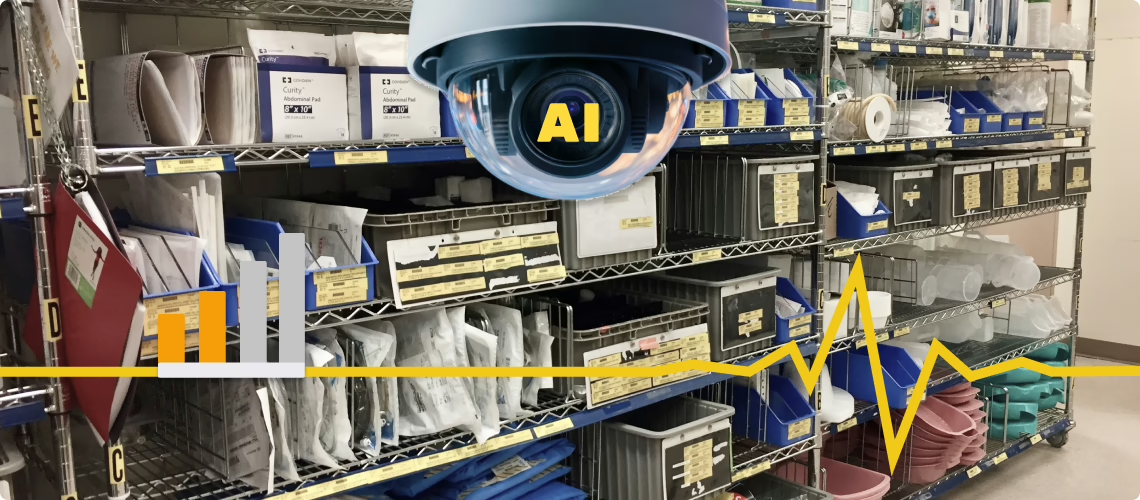
U.S. hospitals waste billions of dollars every year on expired supplies, emergency procurement, and inefficient manual tracking. These failures are not just financial losses. They lead to delayed procedures, safety risks, and compliance penalties. For healthcare executives, supply chain visibility has become a board-level issue. Computer vision AI in healthcare supply chain operations provides a practical path forward. By giving hospitals real-time insight into inventory, compliance, and equipment use, computer vision AI goes beyond diagnostics. It has become an essential part of supply chain optimization.
The Growing Role of Computer Vision AI in Supply Chains
Global healthcare supply chains face constant pressure. Costs are rising, labor is short, regulations are strict, and the demand for precision continues to grow. According to Precedence Research, the computer vision in healthcare market is expected to reach over $53 billion by 2034, with growth above 35% CAGR. Much of this expansion will come from applications that strengthen supply chain resilience, such as inventory automation, compliance monitoring, and predictive demand planning.
Hospitals that invest in AI-driven inventory visibility are already cutting costs, reducing waste, and improving patient safety. As Becker’s Hospital Review notes, supply chain accounts for nearly 30% of hospital operating costs. For executives, efficiency in this area is no longer optional. It is a top priority.
From Imaging to Inventory: Expanding Use Cases
Traditionally, computer vision in healthcare focused on medical imaging, such as identifying tumors or fractures. Today, the same technology creates value in the supply chain, where poor visibility leads to costly inefficiencies.
In surgical supply management, for example, Chooch AI has shown how computer vision can log tool and supply usage automatically. This improves charge capture and prevents over-ordering. Hospitals adopting AI-powered stockout prevention avoid costly emergency orders and delays in patient care.
Computer vision AI also strengthens compliance. In settings with strict accreditation requirements, AI models monitor PPE use, mask-wearing, and hand hygiene automatically. This reduces compliance penalties and removes tedious manual monitoring.
Pharmacy and cold chain management benefit as well. Vision-enabled monitoring verifies proper handling of vaccines and biologics. This prevents spoilage and reduces financial loss.
Why This Matters for Healthcare Leaders
For executives, the case is straightforward. Supply chain makes up almost one-third of hospital operating expenses. Yet many health systems still depend on manual or semi-automated processes. Without real-time data, costs rise, shortages occur, and patient safety is put at risk.
Computer vision AI in healthcare supply chain addresses these challenges directly. It improves inventory accuracy, reduces emergency purchasing, strengthens compliance, and ensures better use of high-value supplies. These results support strategic goals such as sustainability, regulatory readiness, and financial stewardship.
The Technology Behind the Transformation
Adopting computer vision AI is not just about layering new tools onto old workflows. The real impact comes from the underlying technologies that make automation accurate, secure, and scalable within complex healthcare supply chains. What makes this moment different is the maturity of these technologies. Once experimental, they are now robust enough for large-scale deployment in healthcare supply chains.
Edge AI for On-Site Processing
In hospital environments, milliseconds matter. Edge AI processes video feeds and sensor data directly at the source, such as in an operating room or storeroom. This eliminates the need to transmit large files to the cloud. It reduces latency, protects sensitive data inside the hospital network, and triggers instant alerts if supplies are miscounted or mishandled. For executives, this means faster action and lower compliance risk.
Vision Transformers (ViTs) and Multimodal AI for Recognition Accuracy
Healthcare supply chains handle thousands of SKUs that look alike. Syringes may differ by gauge, and implant kits may have near-identical packaging. Traditional image recognition models often rely on convolutional neural networks (CNNs). These systems work well for general image classification but often fail when items look very similar, such as syringes with different gauges or implant kits with nearly identical packaging. In cluttered storerooms, this leads to frequent errors in recognition and tracking.
Generative AI for Demand Simulation and Disruption Planning
Generative AI extends traditional forecasting by learning from large volumes of supply, usage, and external market data. Instead of relying only on historical trends, it creates synthetic demand and supply chain scenarios that expose vulnerabilities leaders might not otherwise see. For example, the model can blend epidemiological data with real-time hospital utilization rates to project sudden spikes in PPE or specialty drugs. It can also combine supplier lead time variability with logistics data to show how a regional disruption could cascade into national shortages. By running thousands of these simulations, generative AI delivers a range of possible futures, complete with probability weights. Procurement teams can then adjust reorder thresholds, identify alternate suppliers in advance, and test mitigation strategies before disruptions occur. This level of scenario planning moves healthcare supply chains from reactive to proactive management.
Real-World Impact: From Stockouts to Sustainability
Healthcare organizations frequently face stockouts of critical supplies or poor tracking of surgical tools. In these cases, computer vision AI in healthcare supply chain provides continuous visibility into inventory, detects early demand signals, and logs supply use automatically.
When applied correctly, this technology reduces reliance on emergency purchase orders, lowers waste, and improves reporting for value-based care contracts. These results are documented across the healthcare sector. They show clear opportunities for leaders seeking measurable ROI.
Moving Forward with Computer Vision AI
The future of healthcare supply chain management will belong to organizations that adopt AI-driven visibility and control. Hospitals that integrate computer vision into inventory, surgical supply tracking, and compliance monitoring will not only lower costs but also safeguard patient care and strengthen resilience.
Ready to explore how computer vision AI in healthcare supply chain reduces costs, improves safety, and prevents stockouts? Schedule a consultation with Chooch to see how our solutions fit your strategic priorities.