

Every hospital runs on supplies, and how it tracks them decides whether shelves stay stocked, budgets stay in line, and staff stay focused on patients. A hospital inventory management system is the tool that does that tracking. The trouble is that the term covers everything from a clipboard and a weekly count to camera AI that updates the count on its own, and those approaches perform very differently.
This guide explains what a hospital inventory management system is, the main types available, how manual, barcode, RFID, and camera AI compare, and how to choose the right fit. It is written for supply chain and materials management leaders who want fewer stockouts, less waste, and cleaner data behind every reorder.
What is a Hospital Inventory Management System?
A hospital inventory management system is the software and hardware a hospital uses to track medical supplies, track how fast they are used, and reorder them before they run short. It records what is on the shelf, what leaves it, and what needs replacing, then feeds that information to the teams and systems that keep supply rooms stocked.
A good system answers four questions at any moment: what do we have, where is it, how fast are we using it, and when do we need more. The difference between systems comes down to how they capture that data, from staff counting by hand to cameras that recognize items as they move.
Why Hospital Inventory Management Systems Matter?
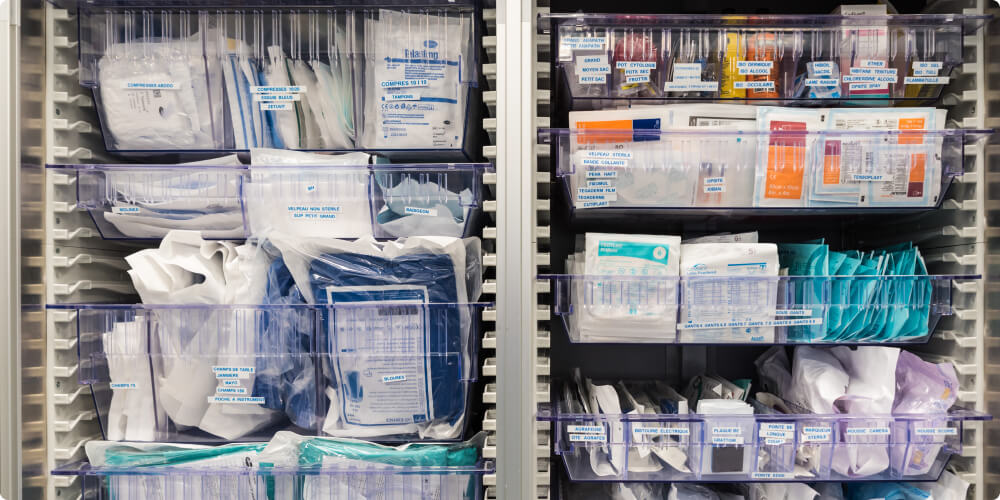
Supplies are one of the largest costs a hospital carries, and the operating room, the cath lab, and the supply rooms hold high-value items that expire. When the count is wrong, the hospital feels it in three ways. Care gets delayed when an item is missing at the point of use. Money is lost to expired stock, rush orders at premium prices, and excess safety stock. And charges go uncaptured when usage is not recorded against a patient.
The common thread is data. Every reorder, every PAR level, and every vendor negotiation depends on the count in the system matching the count on the shelf. The right system keeps those two numbers together without adding work for clinical staff.
The Four Main Types of Hospital Inventory Management Systems
Most hospital inventory management systems fall into one of four approaches. Many hospitals run more than one at the same time.
Manual and periodic counts
The starting point for many facilities is a manual system: staff count stock on a schedule and reorder against a list. It is cheap to start and needs no special hardware, but it is slow, prone to human error, and only accurate on the day of the count. Between counts, the numbers drift.
Barcode scanning
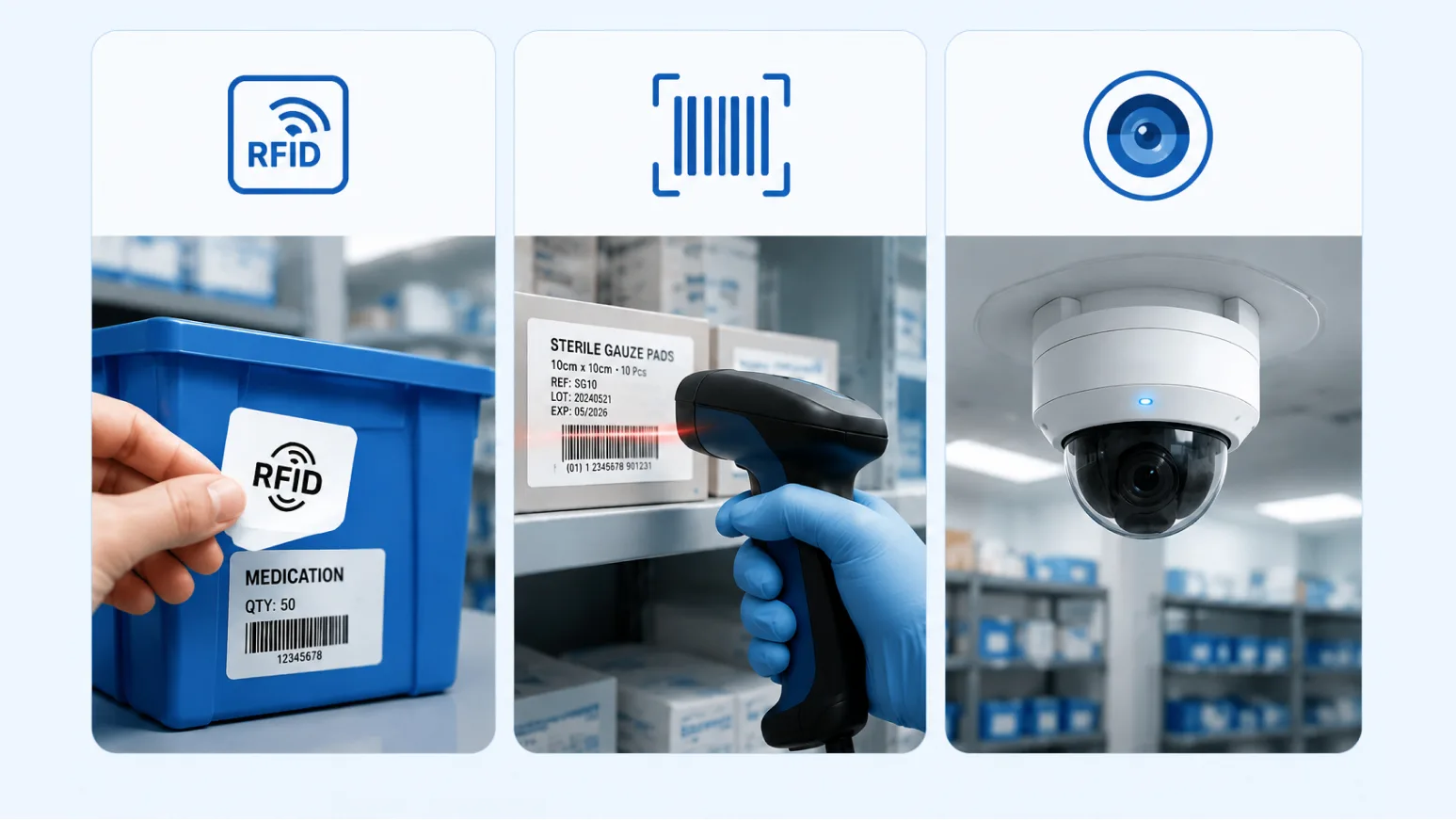
Barcode systems attach a code to each item that staff scan when it is received, moved, or used. Barcodes are inexpensive and widely supported, and they improve accuracy over pure manual counts. The limit is that a barcode only updates the system when a person scans it. In a busy room, scans get missed or happen after the fact, and each item must be scanned one at a time, which slows high-volume areas.
RFID and RTLS
Radio frequency identification tags items so a reader can record them without line of sight, and real-time location systems extend that to track where tagged items are. RFID reads many items at once and does not need a clear view of each tag, which makes it strong for high-value, reusable assets and for tracking movement through a building. The cost is the catch: tagging every disposable is expensive, and readers and infrastructure add ongoing expense and maintenance.
Computer vision AI
Computer vision uses cameras and AI to recognize supplies as they are taken and replaced, with no scanning and no tags. It captures usage as it happens, updates the count continuously, and sends the data straight to replenishment. Because it does not add a manual step or a tag to every item, it fits the way supply rooms already work. This is the approach behind Chooch hospital inventory management.
Hospital Inventory Systems Compared: Manual vs Barcode vs RFID vs AI
The four approaches trade off cost, accuracy, and the effort they ask of staff. The table below sums up how they compare, followed by the detail that matters when you choose.
| System | Capture method | Typical accuracy | Staff effort | Upfront cost | Best fit |
|---|---|---|---|---|---|
| Manual and periodic | Hand counts on a schedule | Low, drifts between counts | High | Very low | Small sites, low-value stock |
| Barcode scanning | Staff scan each item | 80 to 85 percent | Medium to high | Low | Receiving and single-item verification |
| RFID and RTLS | Tags read by sensors | Higher for tagged items | Low once tagged | High | High-value reusable assets and location tracking |
| Computer Vision AI | Cameras recognize items | 99 percent and above | Very low | Medium | Continuous accuracy across supply rooms |
Cost: Manual and barcode are cheapest to start. RFID carries a high hardware and tagging cost. Camera AI sits in the middle, with the main requirement being camera coverage of supply areas rather than a tag on every item.
Accuracy: Manual counts are only right on count day. Barcode accuracy lands around 80 to 85 percent because it depends on someone scanning every item every time. RFID is accurate for tagged items. Camera AI holds accuracy above 99 percent because capture does not rely on staff remembering to scan.
Staff effort: This is where the gap is widest. Manual and barcode both pull clinical staff into counting and scanning. RFID lowers that once items are tagged. Camera AI removes the manual step, which returns time to care.
Line of sight and speed: Barcodes need a clear view of each code and are scanned one at a time. RFID reads many tags at once without line of sight. Camera AI watches the whole shelf continuously, so it does not wait for a scan at all.
The important point is that these are not all-or-nothing choices. Many hospitals keep barcodes at reception, use RFID for high-value trays and implants, and add camera AI in the supply rooms where continuous accuracy matters most.
Is Automated Inventory Tracking Better Than Manual Methods?
For most hospitals, yes. Manual counting is accurate only at the moment of the count and costs a large amount of staff time to maintain. Automated tracking, whether barcode, RFID, or camera AI, keeps the count closer to reality and frees staff from the counting itself.
The size of the gain depends on which automation you choose. Barcode is a step up from manual but still depends on people scanning. RFID and camera AI move capture off the staff, which is where the real time savings and accuracy gains come from. The practical question is not whether to automate, but which method fits your value mix, your budget, and your workflow.
Perpetual vs Periodic Inventory in Hospitals
Two words come up whenever hospitals compare systems. Periodic inventory counts stock on a fixed schedule, for example weekly or monthly. Perpetual inventory updates the count every time an item moves.
Periodic is simpler and cheaper but leaves blind spots between counts, which is where hospital accuracy usually slips. Perpetual gives continuous visibility and is the stronger fit for high-value supplies, as long as the hospital has a reliable way to capture every movement without adding manual work. The capture method decides whether perpetual is realistic: barcode makes it hard because it needs constant scanning, while RFID and camera AI make it practical.
What to Look for in a Hospital Inventory Management System?
Beyond the capture method, the strongest systems share a set of features. Use this as a checklist when you compare options.
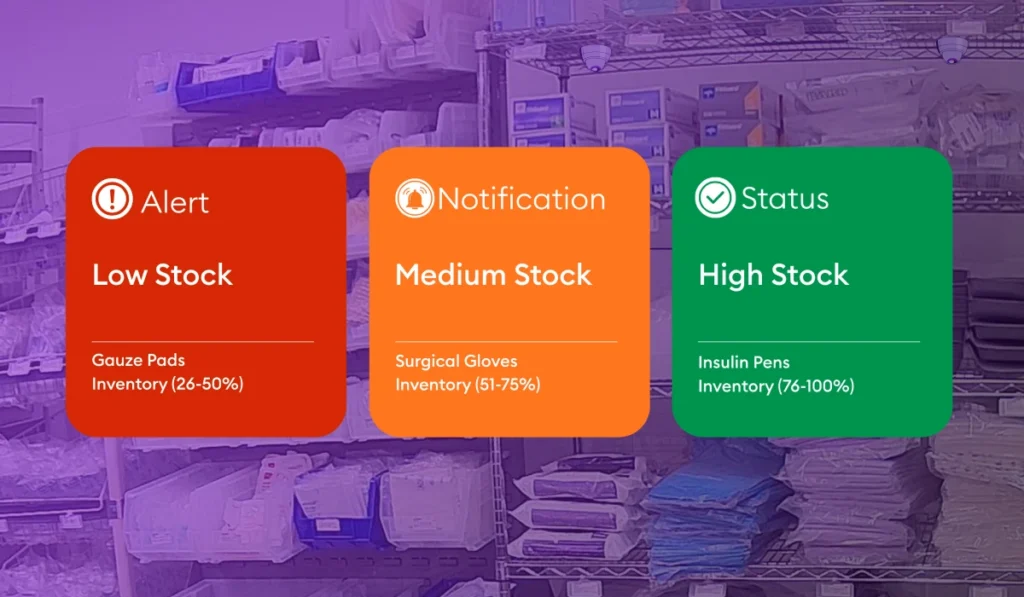
Real-time visibility so on-hand counts update as supplies move, not on a weekly cycle. ERP and materials management integration so replenishment fires automatically on real usage. PAR level management so minimum and maximum quantities are set from real consumption and kept current, a topic we cover in hospital PAR level management. Point-of-use capture so usage is recorded where and when it happens, which also supports charge capture, explained in our guide to point-of-use inventory accuracy. Expiry and lot tracking so near-expiry items are used before they are written off. Demand forecasting so PAR levels adjust to real patterns rather than guesswork, as covered in demand forecasting for hospital inventory. And scalability so one system works across supply rooms, clinics, and multiple sites.
Where Hospital Inventory Systems are Used?
The same core system adapts to several settings, each with its own pressure.
In hospitals, the focus is high-value supplies, operating room readiness, and charge capture. Our guide to operating room supply management goes deeper on the OR specifically. In clinics, the priority is keeping small teams stocked without a dedicated materials manager, so automation that runs on its own matters most. In care homes and long-term care, stock control across many rooms and residents is the challenge, and continuous capture prevents the slow drift that manual counts allow. For medical devices and equipment, tracking high-value, often reusable items and their location is the job, which is where RFID and camera AI both play a role.
How Computer Vision AI Changes Hospital Inventory Management?
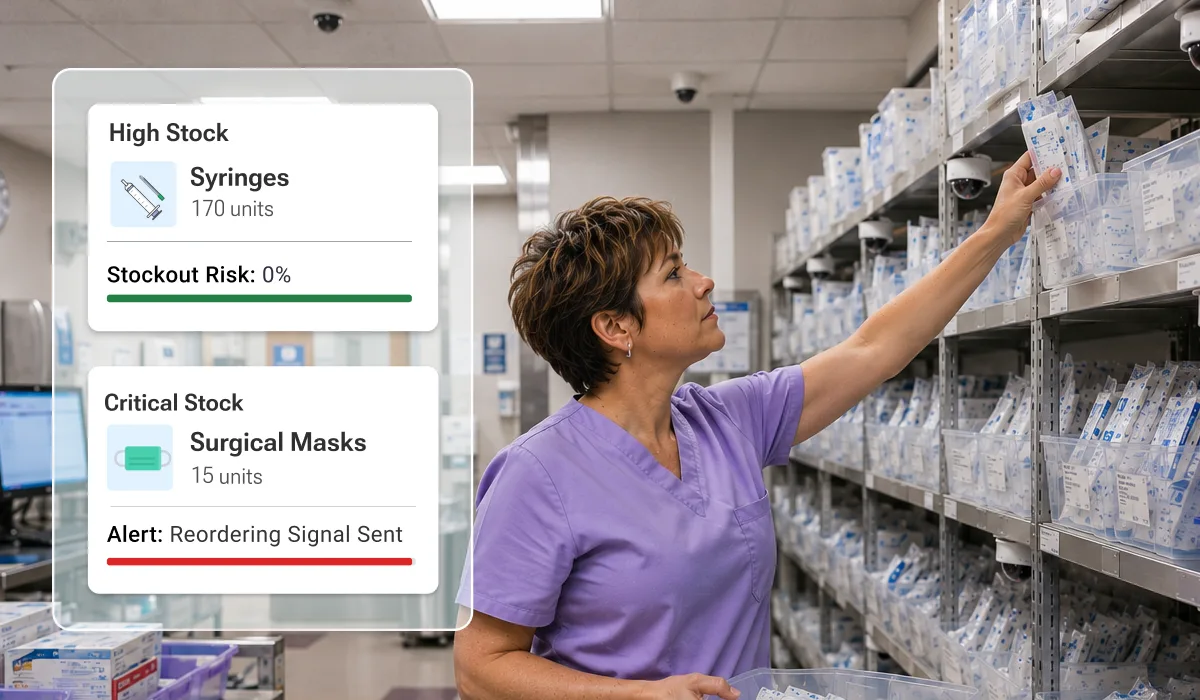
Camera AI removes the step that causes most inventory errors: the manual capture. Cameras watch supply rooms, PAR locations, and case carts, recognize items as they move, and update on-hand counts in real time. Staff do not scan or count, and the data does not wait for someone to enter it later.
That continuous, accurate count does three things at once. It keeps perpetual inventory current so the shelf and the system agree. It supports charge capture by recording what was used. And it gives forecasting clean consumption data, which right-sizes PAR levels and triggers replenishment before an item runs short. Hospitals using this approach have reported inventory accuracy above 99 percent against 80 to 85 percent with manual methods, along with meaningful gains in forecasting accuracy and clinical time returned to care. For a closer look at prevention, see our guide to AI stockout prevention strategies.
How to Choose the Right System for Your Hospital?
A simple sequence keeps the decision grounded.
Start with your value mix. If most of your risk sits in high-value, reusable assets, RFID earns its cost. If it sits in fast-moving supply room stock, camera AI keeps the count accurate without tagging everything. Next, weigh staff time. If counting and scanning are eating clinical hours, favor a method that captures usage on its own. Then check integration. Whatever you choose has to feed your ERP so replenishment runs on real data. Finally, plan for scale. A system that works in one supply room should extend to clinics and other sites without a rebuild.
For most hospitals the answer is a mix: keep barcode where it fits, use RFID for high-value tracking, and add camera AI where continuous supply room accuracy matters. If you want to see camera-based capture in a live stockroom, you can book a walkthrough with the Chooch team.
Frequently Asked Questions
Q. What is a hospital inventory management system?
A hospital inventory management system is the software and hardware a hospital uses to track medical supplies, monitor how fast they are used, and reorder them before they run short. Systems range from manual counts to barcode, RFID, and camera AI, and they differ mainly in how they capture what is used.
Q. Is automated inventory tracking better than manual methods for hospitals?
For most hospitals, yes. Manual counting is only accurate on the day of the count and costs significant staff time. Automated tracking keeps the count closer to reality and frees staff from counting. RFID and camera AI deliver the largest gains because they capture usage without relying on staff to scan.
Q. What is the best scanning method for hospital inventory?
Barcode scanning is the most common and the cheapest to start, and it fits receiving and single-item verification. For continuous accuracy across supply rooms, camera AI is stronger because it captures usage with no scanning at all. Many hospitals use both, matching the method to the task.
Q. Barcode vs RFID: which is better for hospitals?
Barcode is cheaper and fine for single-item verification, but it needs line of sight and one scan per item. RFID costs more but reads many items at once without line of sight, which suits high-value reusable assets and location tracking. The right choice depends on the value of the items and the volume of scanning.
Q. How does computer vision AI compare with barcode and RFID?
Computer vision AI captures usage automatically with cameras, so it needs no scanning and no tags. It holds higher accuracy than barcode and avoids the per-item tagging cost of RFID, in exchange for needing camera coverage of the supply areas it watches.
Choose a System That Keeps Itself Accurate
The best hospital inventory management system is the one that keeps the count on the shelf and the count in your system together without pulling staff away from patients. Manual and barcode depend on people, RFID depends on tags, and camera AI captures usage on its own.
See how Chooch camera AI keeps hospital supply rooms accurate with no scanning and no counting. Explore hospital inventory management or book a 30-minute walkthrough.