

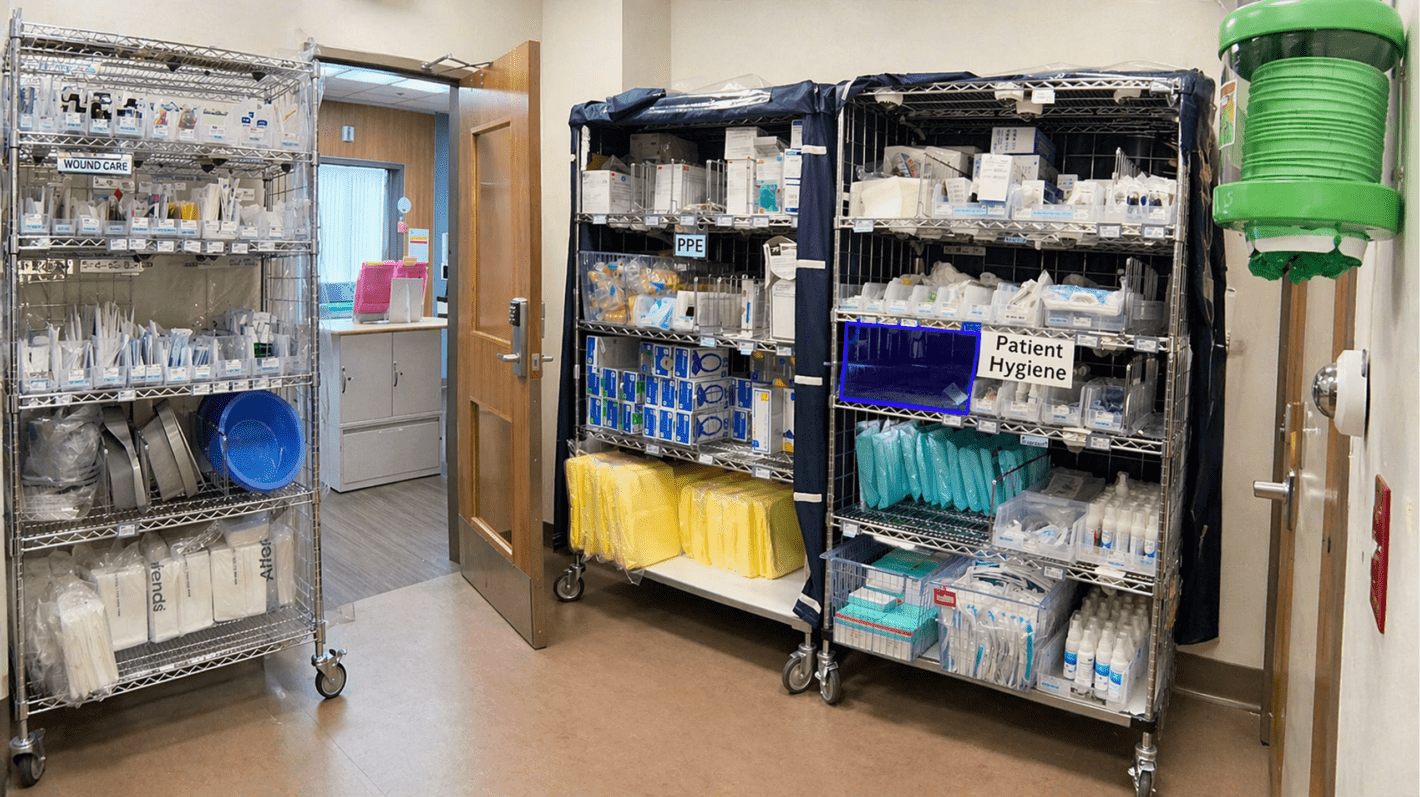
PAR levels are the quiet engine behind a well-stocked hospital. Set them right and supply rooms stay ready without tying up working capital. Set them wrong, or let them drift, and the result is stockouts, rush orders, and expired supplies. Yet many teams treat PAR levels as a number set once and rarely revisited.
This guide explains what a PAR level is, what PAR stands for, what a PAR room is, how to calculate PAR levels with a simple formula, and why they lose accuracy between counts. It is written for supply chain and materials management teams who want their PAR system to actually reflect what is on the shelf.
What is a PAR Level in Hospital?
A PAR level is the ideal quantity of a supply item a hospital keeps on hand for a given location. It sets a minimum quantity that triggers a reorder and a maximum quantity to replenish back up to, so the location holds enough to cover demand until the next delivery without overstocking. PAR stands for periodic automatic replenishment, which describes the cycle: stock is checked on a regular basis and automatically topped back up to the set level.
In plain terms, a PAR level answers one question for every item in a supply room: how much should be here right now. When counts match the PAR, the room is ready. When they fall below it, replenishment brings them back.
What Does PAR Stand For?
PAR stands for periodic automatic replenishment. The name captures how the method works. Periodic means stock is reviewed on a set schedule, for example daily or a few times a week. Automatic means that once a location drops below its set level, a replenishment order is generated to bring it back up. Replenishment is the act of restocking to the maximum PAR quantity.
The term is used across healthcare supply chains, from central stores to the supply rooms and PAR closets on each unit.
What is a PAR Room in a Hospital?
A PAR room is a stocked supply location on a unit or near the point of care that holds items at their set PAR levels. It is where clinical staff pull what they need during a shift, and it is replenished on the periodic automatic replenishment cycle. PAR rooms, sometimes called PAR closets or supply rooms, keep frequently used items close to the bedside so staff do not have to leave the unit to find them.
The accuracy of a PAR room depends on two things: setting the right levels for what that unit actually uses, and capturing what leaves the shelves so replenishment reflects real demand. Both are easy to get wrong, which is why PAR rooms drift out of alignment over time.
How to Calculate PAR Levels?
Most guides define PAR levels but stop short of showing how to set them. Here is a simple, reliable method.
The PAR level formula
The maximum PAR level for an item is the amount you expect to use during the replenishment cycle, plus a safety buffer:
PAR level = (average daily usage x replenishment lead time in days) + safety stock
The minimum level, or reorder point, is the amount that should trigger a new order so you do not run out before the next delivery arrives:
Reorder point = (average daily usage x lead time in days) + a smaller safety buffer
A worked example
Say a unit uses 20 units of an item per day, deliveries arrive every 2 days, and you want 10 units of safety stock to absorb busy days. The maximum PAR level is (20 x 2) + 10, which is 50 units. If you set the reorder point at 30 units, replenishment fires while there is still a day of stock left, and the order brings the shelf back to 50.
The formula is only as good as the usage number behind it. If average daily usage is a guess, the PAR level is a guess. This is why accurate usage data matters more than the math, a point we return to below and cover in our guide to demand forecasting for hospital inventory.
PAR Location Management
A hospital does not have one PAR level; it has thousands, spread across supply rooms, PAR closets, and case carts. Managing them means keeping each location set correctly for what it actually uses. That includes assigning items to the right locations, setting min and max levels per location, and adjusting them as case mix and season change. A level that was right last quarter can be wrong today.
Good PAR location management treats levels as living numbers. Review high-movement items regularly, retire items a unit no longer uses, and add new ones as practice changes, so every location holds what it needs and nothing it does not.
How Periodic Automatic Replenishment Works?
The replenishment cycle is straightforward on paper. Staff or a system check each location on a schedule. Any item below its reorder point is flagged. A replenishment order is generated to bring the item back to its maximum PAR level. The stock is picked, delivered, and put away, and the cycle repeats.
The weak point is the check. When counting is manual, it is slow, it happens only as often as staff have time, and it is only accurate at the moment of the count. Everything that moves between checks is invisible until the next one, which is where PAR accuracy breaks down.
Why PAR Levels Fail Between Counts?
Here is the problem most PAR systems share. A PAR level assumes the count on the shelf is known. But between periodic checks, supplies move without being recorded, so the system number and the shelf number drift apart. By the time the next count happens, the location may already have run short or piled up excess.
Teams often respond by raising PAR levels to create a bigger cushion. That hides the symptom but adds cost and expiry risk, and it does not fix the cause, which is that the count is stale between checks. The real fix is to capture what moves continuously, so the PAR system is always working from a live number rather than a snapshot. We cover this failure mode in more depth in hospital PAR level management and in our guide to point-of-use inventory accuracy.
Best Practices for Managing PAR Levels
A few habits keep a PAR system healthy.
Set levels from real usage, not habit, using the formula above with actual consumption data. Review high-movement items on a regular schedule rather than once a year. Right-size rather than pad, since raising every PAR to avoid stockouts drives waste and expiry. Capture usage continuously so the count stays live between checks. Connect replenishment to your ERP so orders fire automatically on real data, which also supports AI stockout prevention. And align PAR rooms to the units they serve so each location holds what that team actually uses.
How Camera AI Keeps PAR Levels Accurate?
The hardest part of PAR management is keeping the count current without adding work for clinical staff. Camera AI does that. Cameras watch PAR rooms and supply locations, recognize items as they are taken and replaced, and update the count in real time. No scanning, no manual counts, and no waiting for the next periodic check, which minimizes time spent on supply room replenishment.
That live count keeps PAR levels honest. Replenishment fires on real movement, not on a stale snapshot, so shelves stay at PAR without the padding that drives waste, and the system does not overorder. Forecasting gets clean usage data, which is what lets you set PAR levels from reality and adjust them as demand shifts. Hospitals using this approach keep inventory accuracy above 99 percent, compared with the drift that manual counts allow between checks. It is the same camera AI behind Chooch hospital inventory management, and it applies to operating rooms too, as covered in our operating room supply management guide.
Frequently Asked Questions
Q. What is a PAR level in healthcare?
A PAR level is the ideal quantity of a supply item a hospital keeps on hand at a location. It sets a minimum that triggers a reorder and a maximum to replenish back up to, so the location holds enough to meet demand until the next delivery without overstocking.
Q. What does PAR stand for in a hospital?
PAR stands for periodic automatic replenishment. Stock is reviewed on a regular schedule and automatically restocked to the set level, which keeps supply rooms ready without holding excess.
Q. What is a PAR room?
A PAR room is a stocked supply location on a unit or near the point of care that holds items at their set PAR levels. Clinical staff pull supplies from it during a shift, and it is restocked on the periodic automatic replenishment cycle.
Q. How do you calculate PAR levels?
Multiply average daily usage by the replenishment lead time in days, then add a safety buffer. For example, 20 units a day used over a 2-day lead time plus 10 units of safety stock gives a PAR level of 50. The accuracy depends on using real usage data rather than an estimate.
Q. How often should PAR levels be reviewed?
Review high-movement items regularly rather than once a year, and adjust levels as case mix and season change. Hospitals that capture usage continuously can keep PAR levels aligned to real demand instead of relying on periodic manual reviews.
Keep Every PAR Room at PAR
A PAR system is only as good as the count behind it. Set levels from real usage, review them as demand changes, and capture what moves so the count stays live between checks. Get those right and PAR rooms stay ready without the waste that padding creates.
See how Chooch camera AI keeps PAR rooms and supply rooms accurate with no scanning and no counting. Explore hospital inventory management or book a 30-minute walkthrough.