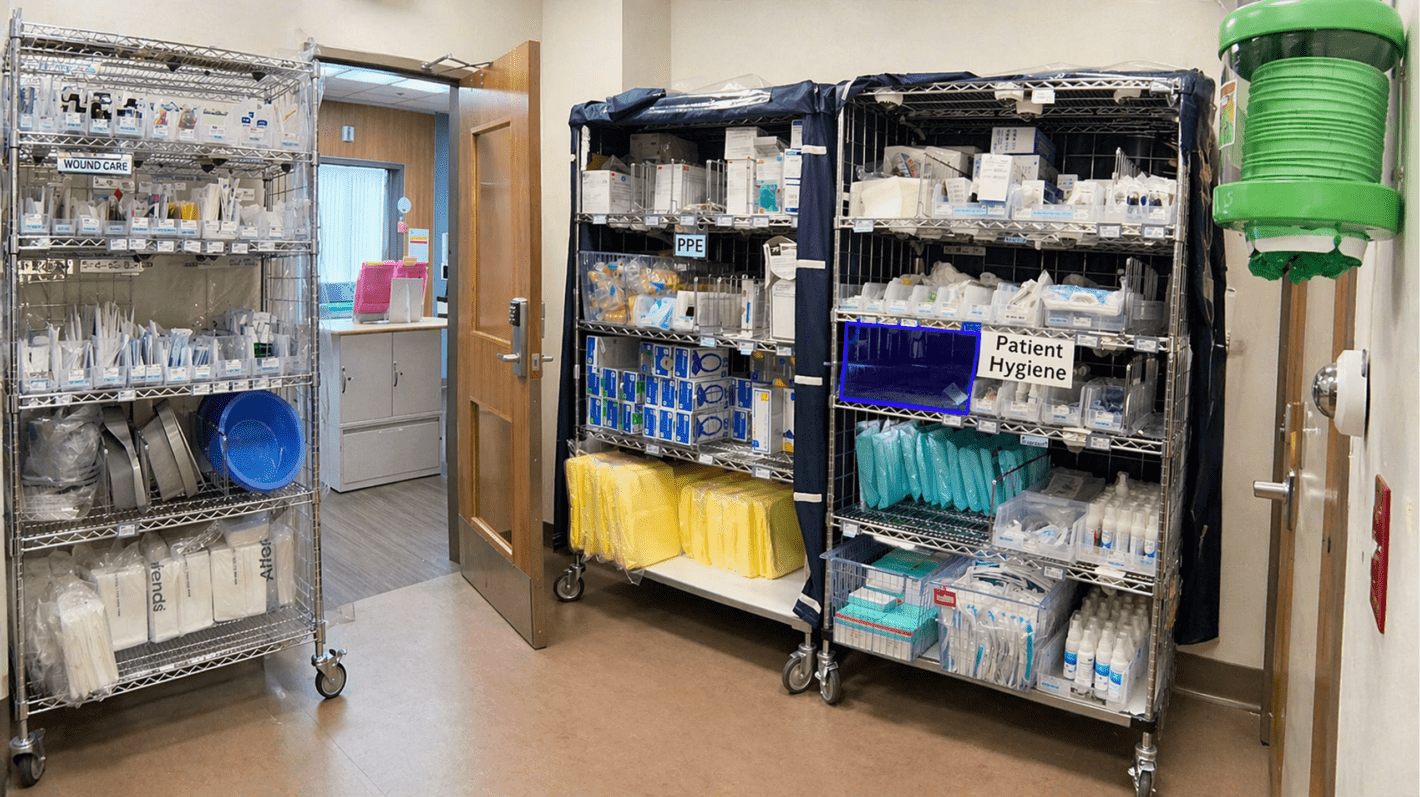


Nurses should not have to become inventory managers to keep patient care moving.
Yet when supplies are missing, difficult to locate, or recorded incorrectly, clinical staff often become part of the inventory process. They check shelves, search another room, ask colleagues, call Supply Chain, find a substitute, or wait while the item is replenished.
No single number captures how much nursing time this consumes across every hospital. The burden depends on the unit, the products being used, the reliability of inventory data, and how often staff need to step away from care to solve a supply problem.
The better question is where that time is being lost – and which supply tasks can be removed from the nursing workflow.
FEATURED IMAGE SUGGESTION: Realistic hospital supply room or medication/supply area with a nurse searching shelves while another clinical task waits in the background. No headline or infographic text on the image.
Where Does Nurse Time Go?
Supply work rarely arrives as one large task. It appears in small interruptions throughout a shift.
- Searching for an item that should be on the shelf
- Checking another supply room when the first location is low
- Calling Supply Chain to locate or replenish a product
- Finding an approved substitute
- Manually checking quantities or PAR levels
- Reporting discrepancies between the system and the shelf
Each interruption may seem minor. Repeated across nurses, units, procedural areas and shifts, however, supply-related work becomes a workflow problem rather than a simple inventory task.
The Most Expensive Part Is the Interruption
The cost of supply work is not only the number of minutes spent walking to a stockroom or checking a shelf. It is also the interruption to clinical work.
A nurse may stop one task to solve a supply issue, then return to the original workflow and re-establish where they left off. If the item cannot be found quickly, more people may become involved.
That is why supply availability matters beyond Supply Chain. The right product needs to be available at the point of care without requiring clinical staff to repeatedly verify inventory themselves.
Why Manual Inventory Work Reaches the Nursing Team
Many hospital inventory processes still depend on periodic counts. A count can confirm what is on the shelf at a specific moment, but supplies continue to move immediately afterward.
Products are consumed, restocked and moved between locations. As the physical shelf changes, the recorded quantity can fall out of alignment with what is actually available.
When that happens, the gap is often discovered by the person who needs the item. In a clinical area, that may be a nurse.
The result is a hidden transfer of inventory work: the system does not know there is a problem yet, so the clinical team becomes the exception detector.
More Counting Is Not the Same as Better Visibility
One response to inventory uncertainty is to count more often. But increasing manual checks also increases the amount of staff time required to maintain the process.
The goal should not be to ask nurses or supply teams to validate inventory more frequently. It should be to reduce how often people need to intervene at all.
When inventory conditions are visible as they change, teams can focus on exceptions instead of repeatedly checking every shelf, bin or supply location.
What Does Giving Nurse Time Back Actually Mean?
Giving time back does not mean removing nurses from decisions that affect patient care. It means removing avoidable supply tasks from the clinical workflow.
That can include reducing the need to search for routine supplies, manually verify quantities, report empty or low shelves, or chase replenishment after a shortage has already reached the unit.
For Supply Chain, the same shift means less time spent on repetitive counts and manual corrections, and more time responding to the exceptions that actually require attention.
A Measurable Productivity Opportunity
| 50% | higher staff productivity |
Chooch reports 50% higher staff productivity in its hospital supply chain results. The opportunity comes from reducing time-consuming inventory tasks and giving teams better visibility into what is available and what needs attention.
How Vision AI Changes the Workflow
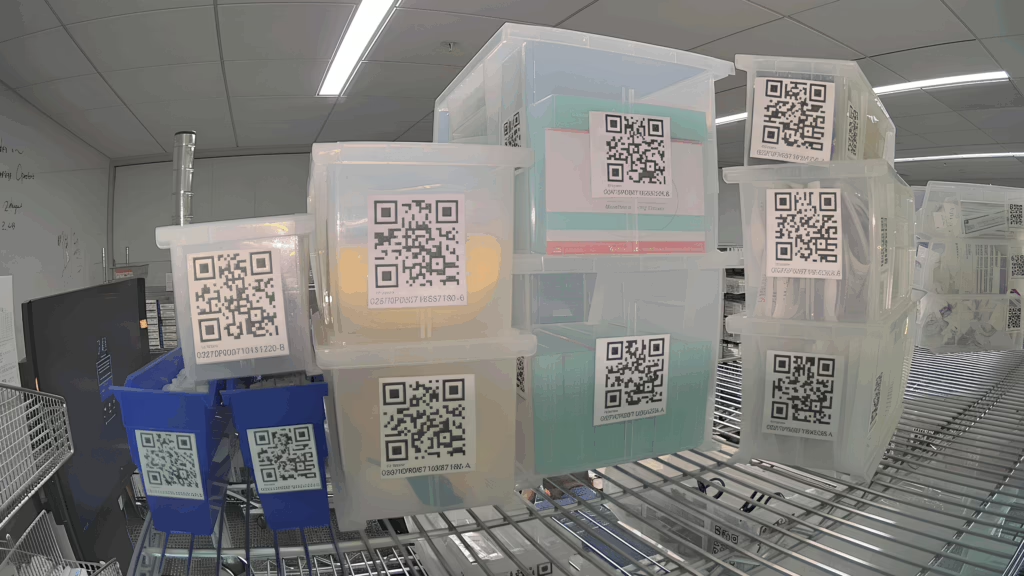
Chooch uses Vision AI-powered smart cameras to track inventory across monitored hospital supply environments without relying on staff to scan, tag or manually count every item.
As inventory conditions change, Supply Chain teams can see what is available and identify low-stock conditions earlier. Replenishment can respond before a nurse discovers the problem during care.
This changes the workflow from manual validation to exception-based action: people step in when something needs attention rather than repeatedly checking inventory to find out whether something is wrong.
From Supply Searching to Clinical Readiness
The purpose of inventory automation is not simply to make counting faster. It is to reduce the number of supply problems that reach clinicians in the first place.
When the right supplies are visible and replenished earlier, nurses have less reason to leave the clinical workflow to search, count, call or correct.
That supports a more reliable point-of-care environment while allowing Supply Chain teams to manage inventory with less manual intervention.
Start With the Supply Tasks Nurses Shouldn’t Be Doing
Hospitals looking to give nursing time back can start by identifying where supply work enters the clinical day.
- Which items are nurses most often searching for?
- Which units generate the most supply calls or urgent requests?
- Where are manual counts still required?
- Which low-stock conditions are discovered by clinicians rather than Supply Chain?
- How often do staff need to leave one supply location to find the same item somewhere else?
Those questions help expose the inventory tasks that have quietly become part of nursing work.
Give Clinical Time Back to Clinical Work
Nurses will always interact with supplies. They should not have to manage inventory uncertainty to use them.
By improving real-time visibility and identifying low-stock conditions earlier, hospitals can reduce avoidable supply interruptions and help keep clinical teams focused on patient care.
See how Chooch Vision AI helps hospitals reduce manual inventory work and improve supply visibility across clinical environments.