

Speakers
Shalom Johnson, VP of Supply Chain and Site Operations, Duke Health
Anubhav Saxena, CEO, Chooch
Welcome and introduction
Anubhav Saxena: Thank you so much for joining. I’m excited to have this conversation with Shalom Johnson, VP of Supply Chain and Site Operations at Duke. Shalom has been a technology leader, a service leader, a sourcing leader and, of course, a supply chain leader.
My name is Anubhav Saxena. I’m the CEO of Chooch, based in the San Francisco Bay Area. Chooch is a global organization with operations in Europe, the US and APAC, and we’ve been around since 2015.
We’re excited to have you here, Shalom. How are you doing?
Shalom Johnson: I’m doing well. I’m very excited to be here, too. I can’t wait for our conversation, Anubhav.
Anubhav Saxena: Thank you for making the time. We wanted to share some insights and have Shalom answer questions we’ve been receiving from the industry: How can we improve real-time visibility into supply chain operations? How do we know how much inventory and how many medical supplies we have? How much are we consuming, and how should we forecast demand?
The big problems we’ve seen are a lack of real-time visibility, automatic counting and reordering, and the data needed for demand planning. We’ll talk about moving from reactive operations to proactive operations.
We’ll play a short video while we wait for others to join. We’ve had an overwhelming response to this webinar. Thank you to our hosts and the Chooch teams who helped make it possible.
Video: Autonomous hospital inventory management
Video narration: Every hospital depends on thousands of supplies being in the right place at the right time.
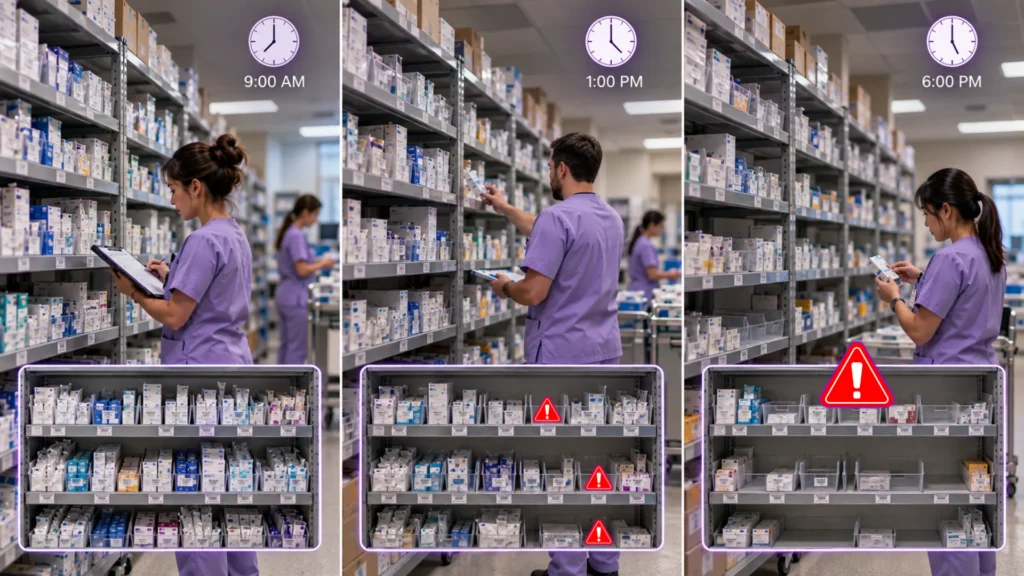
Inventory is spread across dozens of supply rooms and departments, maintained by manual, periodic checks that miss what happens in between. Whether it is barcode scans, RFID, weighted bins or manual counts, by the time a shortage is discovered, it is already too late. Rush orders follow, costs spike and care is delayed.
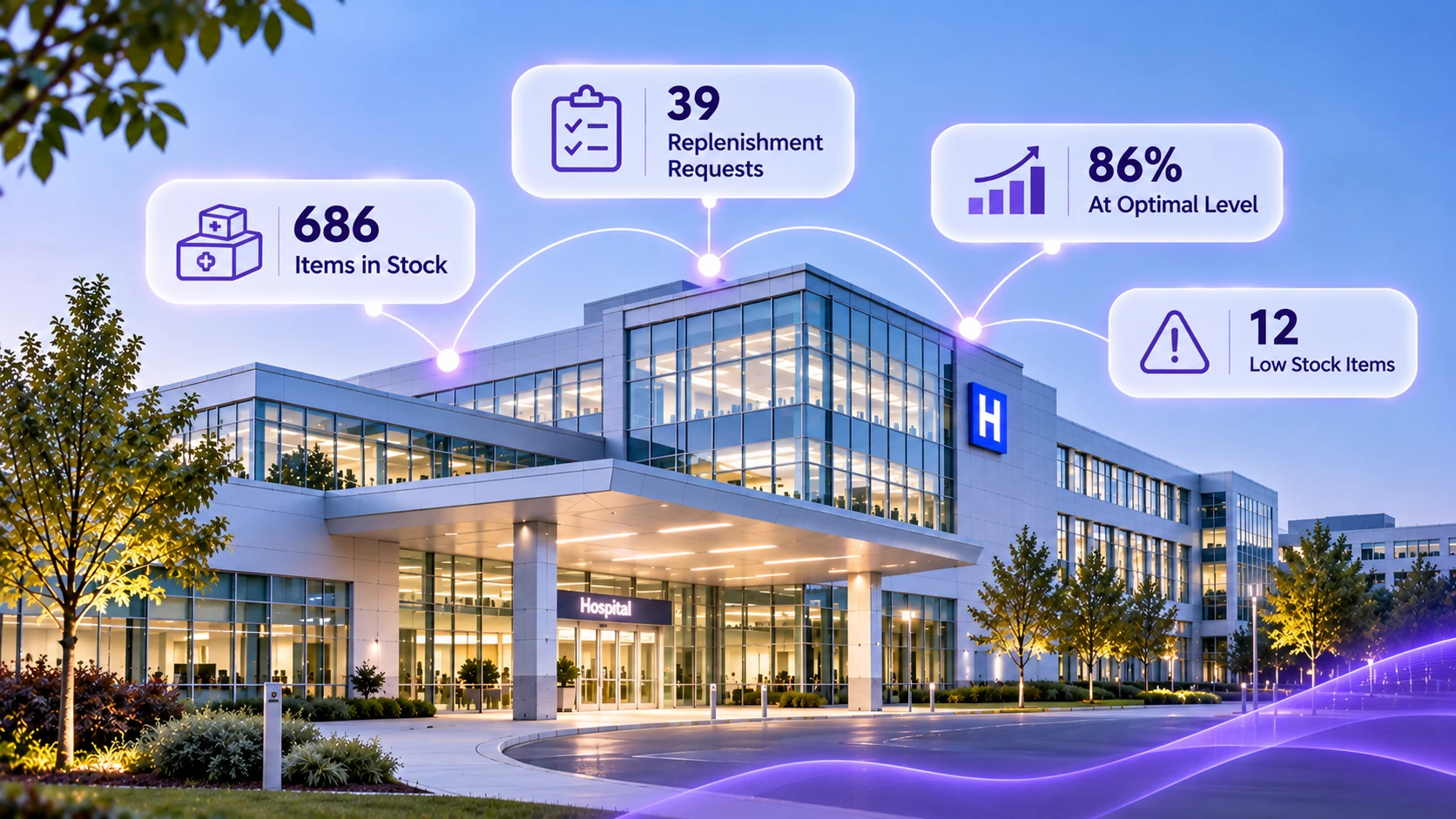
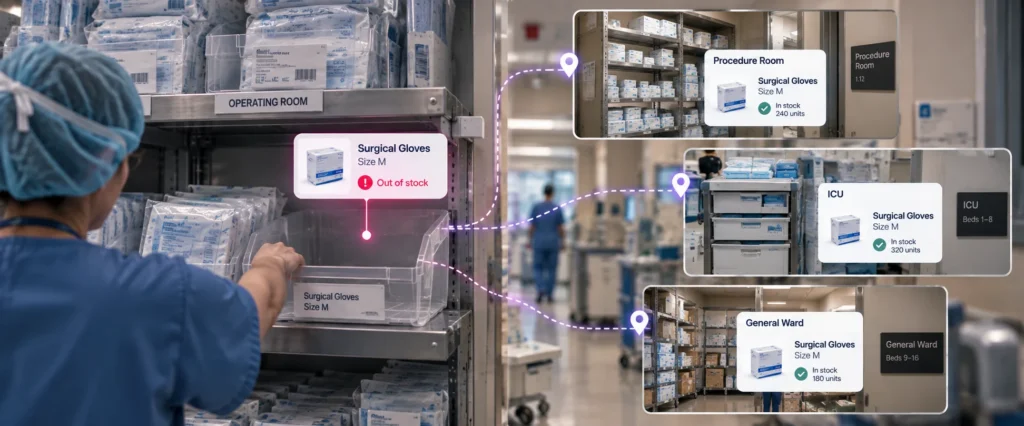
That’s why hospitals are turning to Chooch AI. Chooch’s autonomous hospital inventory management solution uses camera sensors and computer vision to continuously monitor supply levels and usage across hospital supply rooms.
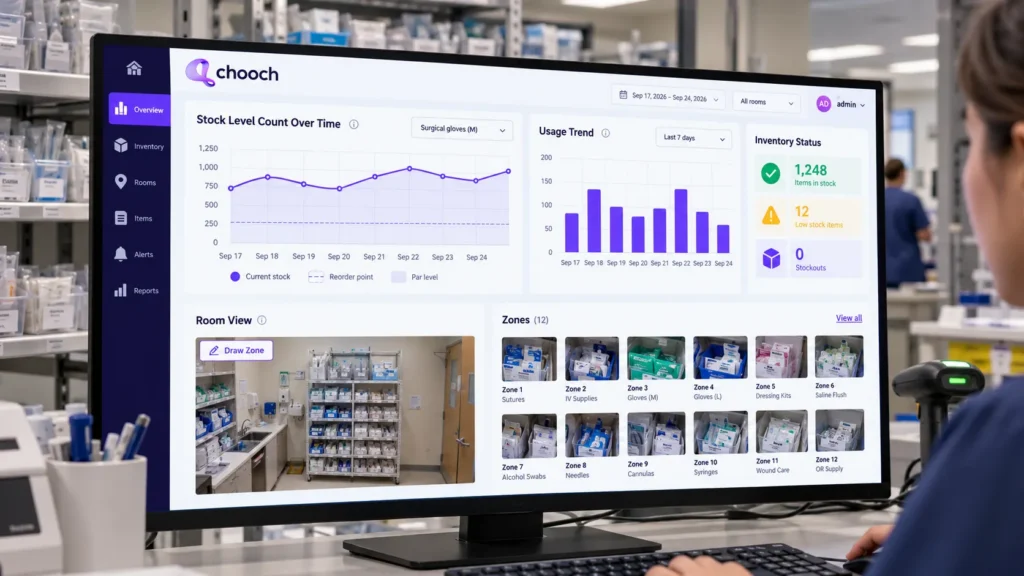
When inventory reaches predefined thresholds, the system automatically triggers reordering, alerts and purchase orders. Through the Inventory Control Tower, supply chain teams gain real-time visibility and centralized control, supported by live data and AI-driven recommendations for demand planning.
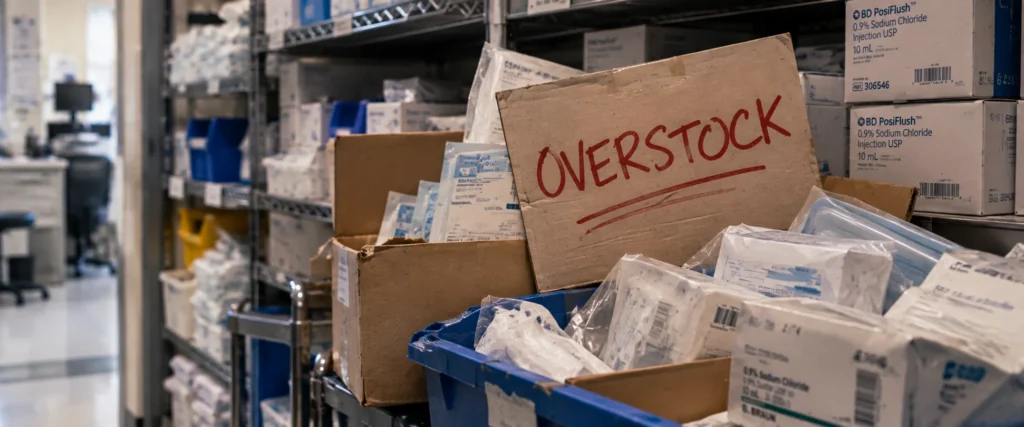
Reduce overstock, stockouts, expired inventory and emergency ordering, and get precise usage levels without manual counts.
Deployed across hundreds of hospital supply rooms and managing hundreds of millions of dollars in medical supplies, Chooch AI delivers continuous visibility and autonomous control across inventory operations, keeping supply rooms ready for patient care.
Autonomous hospital inventory management. Chooch AI.
The challenges facing healthcare supply chains
Anubhav Saxena: Thank you to our clients who work closely with us to co-develop this solution and transform supply chain and inventory management.
Shalom, what industry challenges do you see today, and what continues to make them more challenging?
Shalom Johnson: It’s a great question because I ask myself that all the time, and I talk with my team about it. The question becomes: What isn’t a challenge these days? Whether it’s backorders or a natural disaster, there’s always something.
We’re all facing financial headwinds. There are tariffs, ever-changing federal reimbursement and policy changes. There are also challenges with our workforce. Those are areas we have to continue figuring out within supply chain.
From a supply chain leadership perspective, and for our frontline staff as well, what makes it challenging is that some of those things are outside our control. Tariffs are outside our control. Reimbursement is outside our control. Natural disasters are definitely outside our control.
So, what is within our control? That’s where the conversation around inventory management comes in: being proactive and providing an opportunity for our workforce to engage in ways they haven’t before.
Those challenges aren’t going away. I tell my team that supply chain isn’t what it was five years ago, two years ago or even a year ago. How do we get ahead of that curve?
That’s what we’ve been focused on as we think through what supply chain should look like tomorrow. We’re all here to do the same thing: make sure we’re taking care of our patients.
Anubhav Saxena: There are so many things outside our control, but also many things within it. You’ve done an outstanding job at Duke, adopting a transformational approach to how supply chain can be run.
Why Duke chose Chooch
Anubhav Saxena: What solution choices did you have, and what made you choose Chooch AI?
Shalom Johnson: There are so many solutions and options. But for me and my team, it wasn’t just about the solution. It was about the opportunity for the way forward.
Going back to your original question about the challenges and things we can’t control, the key questions were: What will allow us to be agile in the future? What will allow us to be proactive? What will sustain us? Change continues to happen in our market, and we need a sustainable solution.
One of the things that excited me most about working with Chooch and AI was the opportunity for our frontline team members. They’re in front of our clinicians all the time. We need to set them up for success so they can help our clinicians deliver patient care.
Our main campus hospital at Duke University has a lot of PAR locations to stock and count. The focus became: How do I take out all that extra work? That’s where we started exploring AI cameras.
If I can take that work out of the mix and allow more time for frontline supply chain team members, managers and leaders across the health system to have fruitful conversations with clinicians, that’s what we’re looking for.
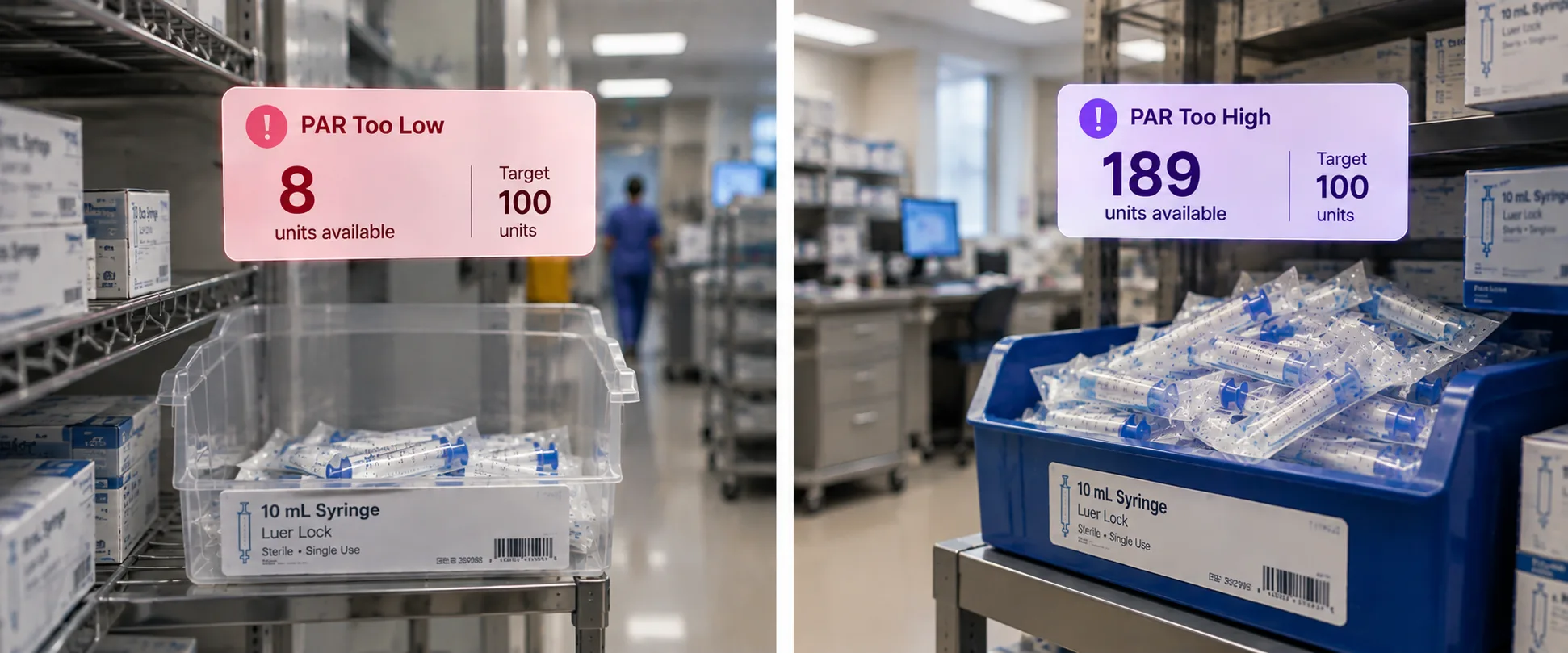
Let’s take it a step further. Everyone knows I’m extremely passionate about PAR optimization and understanding the inventory we have on hand. We developed our own PAR optimization tool internally, but it was using data from three to four months ago. We were trending purchase data and goods receipts, trying to find the perfect answer.
Chooch’s AI cameras allow us to get real-time data at our fingertips. It takes the guessing out of the game. When we have conversations with clinicians, we can show them day-by-day information directly from our dashboard. It builds confidence between supply chain and our clinical partners, and it builds confidence within our team.
Anubhav Saxena: I remember when we first met a few years ago. I’d been to many hospital systems, but I really liked the way you interacted with your chief nursing officer and her teams. The quality of the partnership, trust and confidence you’ve built is exemplary.
You said that, out of all the choices, there was one choice to make: How do we get clinicians spending time at the bedside, providing superior, affordable patient care? Working backward from that choice was insightful.
You talk about the “intelligence behind the intelligence.” You had a PAR optimization module looking at your data. What was missing was the real-time inventory position and the usage graph in the Inventory Control Tower: How is inventory being consumed? What is the seasonality? What is the variability?
PAR optimization takes place using real data. You were building the intelligence behind the intelligence.
For everyone listening, please put your questions in the Q&A section. We’ll try to get through as many as possible during this conversation.
Deployment results: Replenishment time, stockouts and accuracy
Anubhav Saxena: Shalom, what deployment results have you seen so far? We’ve talked about the promise. Is it being delivered?
Shalom Johnson: This gets me excited. When you’re looking at solutions and dealing with a complex supply chain, you’re always waiting to see whether they’ll deliver what you hope they can. This is a challenge we’ve been trying to figure out in supply chain for years.
One outcome I’m most proud of came from my team. I was focused on removing as many manual processes as possible, and those were substantially reduced. But as we tracked the results, the team discovered a huge reduction in replenishment time.
When we compared one room with a similar room that didn’t have Chooch AI installed, replenishment time was reduced by 69–71% over a three-month period. Think about the time that saves across a hospital. The feedback we received from the supply chain associate doing that work was: “This has made my life so much easier.”
It isn’t just the numbers. Our clinical staff told us the room was more organized. It took out the guessing, overordering and understocking.
When we first implemented the solution in that particular area, we were seeing about 8–9% stockouts. Now, we’re at less than 1%. When you think about the nursing and clinical satisfaction that comes from that, you can’t beat it.
Another result I want to talk about is inventory detection accuracy. We’ve ranged between 97% and 99%, and I want to spend a moment on that 97%.
When I asked my team why accuracy had dropped to 97%, they explained that the camera had sometimes been obstructed. We might have moved something in front of it. Our conversation turned to the dashboard, which we can look at any time to see whether something has obstructed the camera’s view.
That’s an important part of the conversation about technology. It’s a partnership between the people deploying it and the technology itself. It’s meant to complement our work. Once we discovered that and had the conversation, we were consistently at 99%.
This is about partnering and creating space to do work that provides value to the system. Overall, we’re very pleased with the outcomes.
There’s another piece I want to highlight. When we deployed, my team did a two- to three-week test comparing what our technician was ordering with what the camera was ordering. Working with your team to review it each day, we found that the camera was ordering more than our technician and was more accurate in those orders.
Doing that dry run was important. It was part of building buy-in. My supply chain team needed to understand the value this would provide.
It also helped raise another question. As we looked at ordering trends, the team could say: “This PAR room has almost 250 items, and it looks like we’re only ordering 20% of them. There’s the space everyone says we don’t have.”
All those pieces play into the metrics, but there are also dynamics we don’t always think about: how we order and how we use tribal knowledge.
Anubhav Saxena: I love that you brought up the test run. It’s important to see whether the platform is performing the job you’ve assigned it, and it also helps build buy-in.
For listeners at the Becker’s Healthcare Conference, another of our clients is speaking about their experiences. Please look out for Jake and hear what he has to say.
Fewer stockouts are so important. With the supply chain challenges, tariffs and logistics issues you mentioned, clinicians need confidence that they’ll find items when they go looking for them. They don’t have to hold supplies in drawers; they can leave them where they belong.
We talk about how to avoid running out without overordering. Overordering leads to expiration, waste and shrinkage, and the holding cost of capital is high.
Can the platform help you get to 40–45% inventory optimization over time? Can it help optimize real estate so more space is available for patient care? There are opportunities around weekend ordering, fewer stockouts, less overordering, lower holding costs, and reduced expiration and shrinkage.
Building buy-in across the health system
Anubhav Saxena: You’ve had a range of roles and a lot of experience in the industry. When you introduce a technology that’s proven but still relatively new, how do you build buy-in across all the stakeholders: finance, IT, supply chain and clinical teams? This is a cross-functional transformation at Duke.
Shalom Johnson: It’s a great question. I hope it doesn’t take me 10 minutes to answer!
Anubhav Saxena: Please take the time.
Shalom Johnson: You’re right. It’s new technology, and it’s something people can be unsure about. One of the things I’m most proud of is the relationships we have at Duke.
When I started looking at this solution, the first thing I did was bring in my chief nursing officer. I said: “There’s something I have to show you. Let’s look at it together and talk about it together.”
We had already been on a journey to deploy two-bin systems across the health system for a couple of years, and we were still on track to deploy them throughout our hospitals. It was important to find a solution that wouldn’t take away from a decision we’d already made. We needed something that could sit on top of that and wouldn’t change nursing workflows.
Finding something where my clinical staff don’t have to do anything is the best thing. I want supply chain work to stay with my supply chain team.
My buy-in started with connecting with clinical staff and our chief nursing officer, and talking about the value this could bring to clinicians.
As a supply chain team, we have two jobs in my opinion. One is to take care of our role so clinical staff can take care of patients. And although we may be far removed, our job is to take care of patients, too. We’re all in the business of saving lives.
That was the conversation about this solution across the board. Our chief nursing officer said we should try it and look at it. Then we talked to nurse managers and clinical directors. We brought them up to speed. We talked to finance about the inventory value, and we brought in our technology team.
What we’ve created is a situation where supply chain isn’t siloed and making the decision alone. Supply chain is developing a solution for the health system.
Having that mentality, understanding and listening to all our stakeholders is the most important thing you can do when bringing in a new solution. That way, everyone is part of it.
Anubhav Saxena: One of the things I admire about your leadership is your ability to bring people along. You’re patient, you sit down with your teams, walk them through it and answer their questions. That builds solid buy-in from all the stakeholders.
Everyone has to believe it’s a transformation program for the entire organization. It helps finance teams forecast spending, supply chain teams understand supplier lead times and supply, and clinicians gain more time at the bedside.
I’ve been going through the audience questions. I’ll answer a few, and Shalom, please jump in with the Duke perspective.
Audience Q&A
Which inventory models and care settings can the technology support?
Audience question — Steve: What options exist for how inventory is managed, such as PAR-based or perpetual inventory?
Anubhav Saxena: Whether you have PAR, perpetual, two-bin Kanban or single-bin systems, this technology can be deployed across medical-surgical areas, perioperative areas, operating rooms and cath labs. It can work across storage system types.
Shalom Johnson: We’re also looking at two other areas that I think could be transformational.
We all understand the difficulty of managing inventory and ordering in non-acute settings. We’re exploring whether we should use AI cameras in our clinics. Those are lean environments, and clinicians don’t have much time or bandwidth. In a health system spread across a state or into other states, how do we create a sustainable solution for them?
We’re also looking at some of our storerooms. We’re looking at deploying the technology in a new storeroom at one facility. It’s a large, open space, so we’re having conversations about whether we can use AI cameras there to take us away from manual inventory and cycle counting. Let the cameras do that work for us.
Anubhav Saxena: That’s a good point. Smaller facilities don’t have the luxury of a large supply chain team. How do you support them? Looking at non-acute settings, storerooms and warehouses helps connect the upstream, midstream and downstream parts of supply chain.
For those on the call, we also work with Henry Schein and issued a press release about the non-acute space. Duke partners with them as well.
Does the solution require a particular type of storage unit?
Audience question — James: Is it necessary to have the storage units shown in the video, or can cameras be fitted to smaller units?
Anubhav Saxena: We work with Metro racks, louvered systems, bins and open shelving. Shalom, I’d love your perspective.
Shalom Johnson: One thing we’ve explored, but haven’t done yet, is using it in our older tower on the main campus. We have a clean room behind a door, but also open spaces on each side of the floor that we call nursing stations.
We went there and asked what we could do to have cameras in those spaces. First, it was important to confirm that images of people could be blurred.
The second piece was being creative. As we’ve explored it, we feel we could probably get there, but it would take some creativity with the shelving. Because these are open spaces, supplies also have to be behind closed cabinet doors. Your team provided some possible solutions for that.
I think there’s a lot of flexibility. It’s about having conversations, looking at layouts and figuring out what works best.
Anubhav Saxena: Cameras are like digital eyes. As long as they can see the inventory, they can count it automatically and support reordering. Open shelving and different cabinet types are in scope, subject to that visibility.
How many locations could Duke support, and do cameras need Ethernet?
Audience question — Mark: How many inventory stocking rooms do you expect to support at the flagship facility? Do the cameras run on Wi-Fi, or do they need Ethernet or a specific data hub?
Shalom Johnson: I’ll let you answer the networking part, Anubhav. We’ve had a lot of conversations about this.
Right now, we’re exploring our inpatient rooms. We have quite a few projects underway across the system. At Duke University Hospital, our main campus hospital, we have more than 500 PAR locations, including the clinics on site.
From my experience, and from having your team come out to other areas, there’s a lot of flexibility in camera spacing and placement.
Anubhav Saxena: If you have an Ethernet port in the room, that can be used. The two things you need to provide are an Ethernet port and a working power supply.
In older hospitals, there may not be Ethernet ports, and that’s fine. We bring a Wi-Fi device that connects to the hospital’s Wi-Fi.
The camera takes images at predetermined intervals, so the network load isn’t very high. Those images go to the inference engine, which counts how much inventory you have. Ethernet and Wi-Fi can both work.
Duke has community hospitals as well as its main facility. Some have Ethernet, some use Wi-Fi, and newer facilities have networking built in. There’s flexibility across those settings.
Can Chooch integrate with EHR and ERP systems for charge capture?
Audience question — Brandon: Our current PAR system connects to our EHR for patient-chargeable supplies. How does Chooch handle that? Are there charge capture integrations?
Anubhav Saxena: Chooch has workflows for patient charge capture, recalls, returns and case pick lists in higher-cost surgical and procedural areas.
We integrate with Epic and ERP systems. At Duke, we integrate with SAP. We also integrate with systems such as Oracle, Allscripts, PeopleSoft and Workday.
Shalom, would you like to add anything?
Shalom Johnson: I think you did a great job answering that.
Does the system track items returned to shelves?
Audience question — James: Is it being used to record when items are returned to shelves?
Anubhav Saxena: Yes. Clinicians may take more than they need, then return some items. Because the camera takes snapshots at intervals, the usage graph updates to show that a certain quantity was taken and another quantity returned. You can see quantities over time.
It also accounts for substitutes, recalls and returns. The intelligence can show items that are consistently empty or consistently full.
Shalom Johnson: This goes back to my passion for PAR optimization, stockouts and managing inventory with real-time information.
I was looking at the dashboard today while discussing Chooch with someone. Items are highlighted by usage and stock levels. One item was listed as critical and had been critically low for two or three weeks.
Now I have that data and can see it day by day. The question becomes: Is this an anomaly? Is it due to patient census? Is it a flu outbreak? What’s driving it?
As a supply chain team member, you have the information you need for a data-based conversation with your clinical team. You can make decisions and say: “This is what we’ve seen over the last couple of weeks.”
It moves us from being a reactive partner to a proactive partner. It also builds confidence that supply chain knows its business and understands how products move. We have the information readily available.
Anubhav Saxena: The confidence and trust you can build on that foundation of data are so important.
Did Duke have to reconfigure shelves and bins?
Audience question — Barbara: Did you have to reconfigure shelves and bins to implement the cameras? What other structural and labeling changes were involved?
Shalom Johnson: When we decided to implement, we did a full PAR optimization at the beginning. That allowed us to look at space and constraints and start fresh. We wanted a baseline so we could see where we were and where we would be later.
There was some shelving reconfiguration, but that was a decision we made because we wanted to increase some PAR levels and decrease others.
Across the system, I’ve tasked my team with making sure we never have less than three days of inventory on hand. If we can find the space for five or six days, I want us to have that.
That work wasn’t necessarily because we were installing AI cameras. It was our baseline work. The ability to come in and put cameras where they need to be is there. We wanted to do an end-to-end optimization of the room so we could establish a baseline and understand where we were three or four months later.
Anubhav Saxena: When we visited last year, you pointed to a room and asked how we would do it. That room had two-bin Kanban, Metro racks and louvered wall-hanging bins.
Your guidance was clear: Don’t interrupt clinician workflows, and don’t change existing investments. Our teams had to figure out the mounting. We used near-distance and far-distance cameras. Some went on racks, some on walls, depending on what they needed to see.
You don’t have to reconfigure shelves or bins to implement the cameras. There is a balance between the shelving type and how many cameras you need.
At some client sites, older high-density cabinets were expensive, costly to maintain or disliked by clinicians. In those cases, changing them made sense and reduced total cost of ownership. But most clients don’t need to change their existing shelving.
The technology was co-developed with a longstanding health system that had a wide variety of shelving and racks. It was designed to work across those types. Changes usually come down to whether a client already has a problem with a particular shelving system.
Can cameras track lot numbers, serial numbers and expiration dates?
Audience question — James: Can the system track attributes beyond quantity, such as lot numbers, serial numbers and expiration dates?
Anubhav Saxena: Yes. A camera can read labels, QR codes, barcodes and text. Think of AI models as the brain you give the camera to read what you want it to read. If you want it to look for quantity, it looks for quantity. It can also read lot numbers, serial numbers and expiration information.
How does the technology support stock, non-stock and consignment workflows?
Audience question — Adam, summarized by the host: How does the solution account for replenishment across stock, non-stock and consignment inventory? How does it support the workflow from case preparation through consumption, returns and replenishment?
Anubhav Saxena: Those are individual workflows: stock, non-stock, stockless, consignment and so on. We overlay the cameras and AI platform onto each workflow to see what can be automated and where AI makes sense.
Then we assess it against a business case and ROI calculator: Are we saving time? Are we improving accuracy? Are we recording beneficial results from applying technology to this workflow?
It’s a detailed question. The technology can be applied to operating rooms, cath labs and interventional radiology labs, but each has a unique workflow. There can also be differences in standardization between operating rooms across a large hospital system.
We need to look at how each workflow is managed today, whether we can move toward standardization, and whether the technology overlay is worth the effort. In nine out of ten cases we’ve looked at, we’ve seen it work, but it depends on the workflow and level of standardization.
Shalom Johnson: I think that’s appropriate. As you know, we don’t have it in our procedural areas.
How do you build a financial case for investment?
Audience question — Robert: Did you experience dollar savings? It’s hard to convince an organization to invest without tying the initiative to tangible dollars.
Shalom Johnson: That has to be part of the conversation. You can show savings in multiple ways.
For us, in this particular room, I needed to get to a standard for days of inventory on hand. At the beginning, I was more focused on increasing inventory because I wanted to move away from touching every item and going into every room every day, sometimes twice a day.
My initial focus was on labor. Being able to show savings from a labor perspective, and then scale that up, has been tremendous for us. So the answer is yes.
Now that we feel comfortable with our minimum of three days on hand, we’re looking at where we can reduce PAR levels. Because we have the data, our clinical team is ready for that.
The way to approach the conversation is to be conservative and determine what you can save from a labor perspective, a space perspective and a PAR perspective.
You still have to account for things outside your control, such as natural disasters and backorders. We use a low-unit-of-measure distribution model across our health system, so I need to make sure we have enough days on hand.
I included that in my conversation with finance. I was clear that we were trying to reach stabilization first. Once we feel stabilized, we can start seeing inventory dollars come down where appropriate.
Anubhav Saxena: I’ll share what another client has reported. We were invited to a client’s board meeting in June 2026, where they presented transformational savings of approximately $86 million, representing about a four-times return in a net present value model.
More than $60 million was attributed to PAR and inventory optimization, and about $20–25 million to labor improvements, including productivity savings and efficiency improvements.
Most clients building their business case aim for at least a 3.5- to 5.5-times return on the dollars spent. We can provide more detail as we build that case with you.
How much replenishment comes directly from a distributor?
Audience question — Mark: What percentage of replenishment in nursing-unit supply rooms comes directly from a distributor, versus a storeroom in the building?
Anubhav Saxena: You use Owens & Minor. How much comes directly from the distributor?
Shalom Johnson: As I mentioned, we use a low-unit-of-measure model. I’d put us at about 80–85% coming from a distributor direct order, with a lot of that in our perioperative spaces.
I’ve worked hard with my team to move as much as possible out of our storeroom and to our distributor partner. That’s why the number is high, and we continue to make progress.
Like everyone else, we don’t have a lot of room. Our storeroom is intended to be a backup for critical supplies. I tell my team that I don’t need us operating as many distribution warehouses within our hospitals. That’s what we have our primary distributor for. Our storerooms are for critical items.
Anubhav Saxena: Some of our other clients use Medline. When the fire at the Tracy facility happened, they told us Chooch helped them organize supplies across their storerooms, warehouses and locations and move them around quickly.
We also have clients working with Vizient and Cardinal Health, using a range of inventory workflows: low-unit-of-measure, PAR, perpetual, stock and stockless. We’re happy to discuss those approaches offline.
Does the system check expiration dates?
Audience question — Tracy: Does the system work with expiration date checking?
Anubhav Saxena: Yes, it looks at expiration dates as well.
Is Wi-Fi supported, and can staff be reassigned to other work?
Audience question — Jeremy: Do you have Wi-Fi transmitters, and were you able to repurpose people?
Anubhav Saxena: Yes, Wi-Fi transmitters are available, and Ethernet also works, as we discussed.
Most clients reallocate work among their people so they can focus on more strategic activities rather than counting supplies and reordering. Shalom, how were you able to repurpose people?
Shalom Johnson: For us, it isn’t about reducing labor. It’s about using the AI solution as a partner to help us work smarter and have data at our fingertips.
I like to use this analogy: “It’s not that you’re not needed. You’re just needed differently.”
In our PAR areas, and in what we’re exploring for the storeroom, I want team members to ask: Is this item placed appropriately? Are we picking it fast enough? What’s the return on improving picking or moving items into distribution?
I want them looking at expiration dates, working with vendors and focusing more on inventory management.
If I can get time back through the replenishment time reduction we discussed, I can have my team member spend that time talking with nursing. They don’t have to run around trying to find products. They can proactively work with the inventory control team.
So yes, we have repurposed people, and we can continue to do that. The goal is to keep looking at how we can do the work differently.
Anubhav Saxena: That’s a great point: How can you do the work differently?
Where can viewers see the demonstration video?
Audience question — Craig: Could you share the video and show how this works?
Anubhav Saxena: We played the video at the beginning, and we’ll see whether we have time to play the 90-second video again. A video is also available on chooch.com. Please reach out if you’d like to see more.
How many items can one camera cover?
Audience question — Mark: How many items, or how much linear space, does a camera cover?
Anubhav Saxena: It depends on the shelving type. There are near-distance and far-distance cameras. The approximate SKU-to-camera ratio can vary, with examples of 16, 24 or 45 SKUs per camera, depending on the layout and density of items in bins or on open shelving.
It depends on how far the camera can see and how much is visible to it.
Which metrics did Duke use to assess success?
Audience question — Sandra: What metrics allowed Duke to say the solution was successful?
Anubhav Saxena: Shalom looked at stockouts, inventory optimization, replenishment time, labor efficiency and productivity benefits. We’re happy to share more about those metrics and what other clients are seeing.
How many cameras does a typical supply room need?
Audience question — Hayden: Approximately how many cameras are used in a standard medical-surgical supply room? Is there a camera directly above each supply bin?
Anubhav Saxena: No, there isn’t a camera above every bin. That would be too many cameras.
A room might have five to seven cameras, depending on whether it uses two-bin Kanban, Metro racks or another arrangement, and how many SKUs it contains. A standard medical-surgical room might have around 100 SKUs, give or take. Some rooms need fewer cameras, depending on the wall-mounted or louvered bin configuration.
How frequently do cameras capture images?
Audience question — Mark: What is the interval between photographs?
Anubhav Saxena: It could be one hour, two hours or 15 minutes. You can decide the frequency based on the criticality of the items. The configuration is flexible.
We’ve found hourly snapshots to be a useful balance. We see about 15–20% of a room changing each hour, so hourly intervals can provide a useful usage graph for business planning and demand forecasting.
Who monitors the inventory data throughout the day?
Audience question — Blaine: Who is monitoring the data throughout the day?
Anubhav Saxena: The Inventory Control Tower monitors inventory. You don’t need dedicated team members to populate the usage graph; that process is automated.
We call these autonomous PAR rooms. They automatically monitor, count, update and reorder. For those with Gartner access, there’s a recent article on autonomous PAR rooms. If you don’t have access, reach out to us for more information about the report and related material.
Shalom Johnson: I do think it’s important to monitor your dashboard, because there’s a wealth of information there.
Throughout the day, especially in inpatient units, things can change depending on patient census and what’s happening. Team members may move things around. The beauty is that you don’t have to wait for someone to tell you; you can see it on the dashboard.
My managers across the main campus have access so they can go in and look at any moment. I think that’s an important feature of the Chooch AI system.
Anubhav Saxena: Thank you. This has been a very active audience. We’ve worked through most of the questions. Alexander, Kevin and Adam, we’ll need to move to our next topic, but we can follow up on your remaining questions offline.
The future of healthcare supply chain
Anubhav Saxena: Shalom, you’ve talked about building buy-in, communication, change management and bringing teams along. What future technologies excite you? We have cameras and AI. How do you feel about voice activation and PAR optimization?
Shalom Johnson: We’ve had a lot of conversations about PAR optimization and having that built into Chooch. I think that’s the next wave of helping us transform and become better prepared, as other industries are, for when disasters happen.
That excites me because when we talk about repurposing our teams and making sure AI technology is a partner, we need tools to do that. This is one way to get there.
Five years from now, I want to sit back and say we’ve transformed how we do supply chain in healthcare. You often hear that healthcare supply chain is behind everyone else. I want us right next to everyone else, or ahead, because we’re in the business of saving lives.
Our clinicians love the idea of voice activation: being able to go into a room and ask where a syringe is, and get an answer. Nurses may move from unit to unit, and we have traveling nurses, so that ability is valuable.
It’s important to keep looking forward. But I also want to say that the future of supply chain is our people.
When I think about the opportunity for frontline staff to be part of a major transformation, that excites me more than anything. We have young people coming in who may think of supply chain as just getting a foot in the door. Being part of something like this makes them want to bring both feet in and be part of the change.
I started in supply chain in college and never left. I want to see that throughout the industry.
Anubhav Saxena: You’re an inspiring leader, Shalom. I’m inspired by leaders who want to improve their own organizations and help transform the industry.
Technology alone doesn’t change the world; people do. It comes down to leaders who can take technology, implement it and leave a strong legacy for future supply chain leaders.
A hospital system CEO once said to me: “A hospital is three things: staff, space, stuff. You help me with the stuff. I’ll do the rest.”
We’re keen to continue partnering with Duke and with you, Shalom. It’s been an inspirational journey. Thank you to you, our clients, partners and hosts for making this possible.
We’ll finish with the 90-second video that was requested. Thank you for joining us, and we look forward to staying in touch.
The autonomous hospital inventory management video shown earlier is replayed.
Anubhav Saxena: Thank you once again, Shalom, and thank you to everyone who joined and helped host the webinar. Have a great day and week ahead.
Shalom Johnson: Thank you. Bye-bye.