
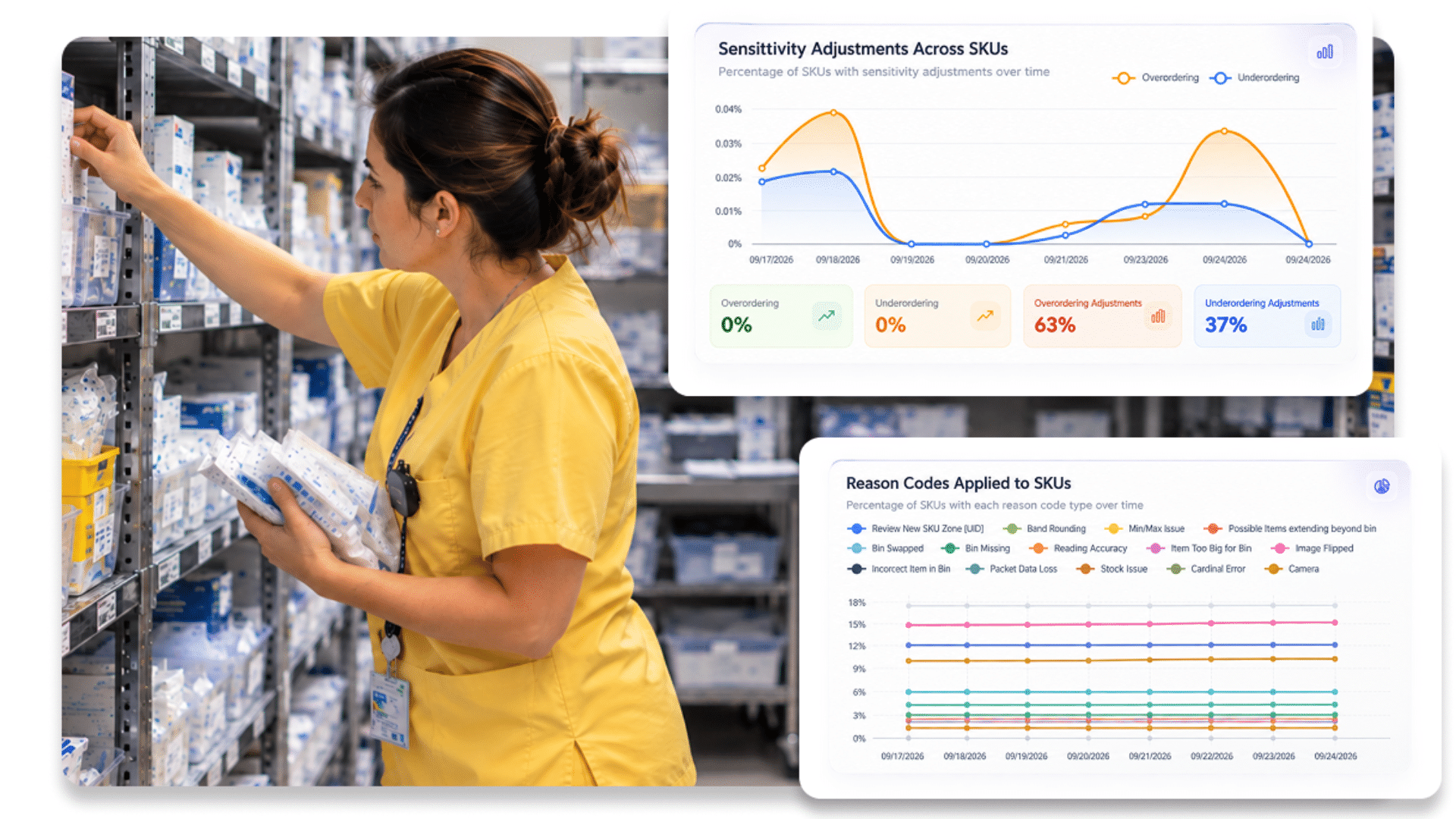
How data informed PAR analytics can help supply chain teams balance product availability, storage space and replenishment routines.
Why PAR levels deserve a second look
Every hospital supply room needs a practical answer to two questions: how much of an item should be kept on hand, and when should more be ordered? PAR levels, minimum and maximum inventory targets, help teams make those decisions. Yet the starting numbers are often estimates, carried forward from earlier routines or adjusted only after a shortage becomes visible.
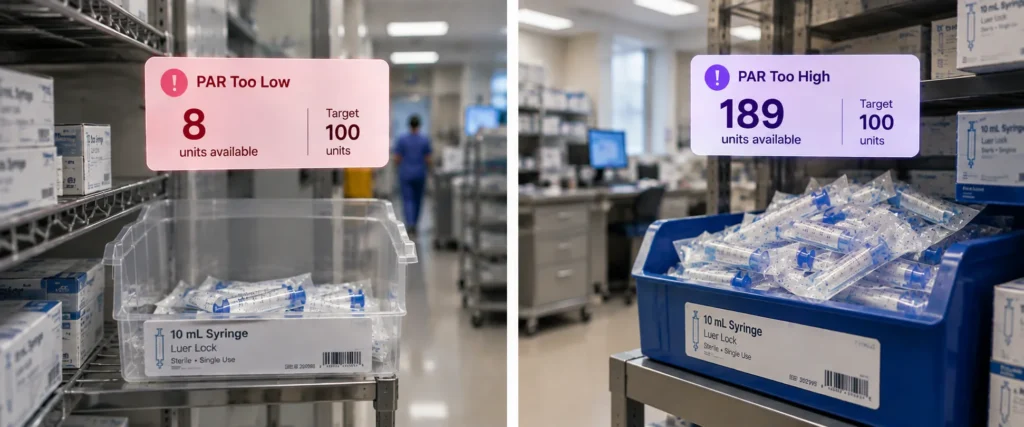
That approach can create two problems at once. Some frequently used items run low between replenishment cycles, while other products occupy valuable shelf space without being used at the same pace. Neither situation is solved simply by adding more stock across the board.
PAR Analytics and Optimization from Chooch is designed to make these decisions more based on evidence. It uses available ordering history and supply room information to recommend starting levels, examine alternatives and help teams revisit their choices as usage patterns become clearer.
Start with the data hospitals already have
Improving PAR levels does not have to begin with a complicated forecasting project. The first step is to bring together the information that describes how a room operates: past orders, the items being stocked, the bins they occupy and the racks or locations where they are stored.
The quality and completeness of that information matter. Chooch PAR Analytics identifies which analyses the available data can support, rather than treating every room as though it has the same history. For supply chain leaders, this creates a more transparent starting point for discussion.
Imagine two supply rooms that carry the same dressing. One sees consistent demand throughout the week; the other experiences peaks on particular days. Giving both rooms the same PAR setting may be convenient, but it may not reflect how they are actually used. Looking at ordering patterns and room-level information helps teams evaluate whether different targets are appropriate.
Choose the inventory outcome before changing the number
A good PAR review starts with the outcome the hospital wants. Is the immediate priority to reduce stockouts? Is a room frequently overfilled? Are teams trying to balance availability with limited storage capacity? Different objectives may lead to different recommended minimum and maximum levels.
Chooch PAR Analytics lets teams select inventory goals and review proposed PAR recommendations against them. This is more useful than treating the suggested number as a fixed instruction. Supply chain managers can consider the operational trade-offs, discuss recommendations with stakeholders and decide which changes make sense for the room.
This is especially important for items with different patterns of use. A frequently requested product may need a different buffer from a slower-moving item, even when both are essential to the room. The aim is not to minimise inventory at any cost; it is to align stocking decisions with the service level the hospital is trying to maintain.
See the decision inputs at a glance
The illustration below shows the basic idea: combine the history of what has been ordered with the physical context of the supply room, then review proposed minimum and maximum levels. It is a simplified view of the decision process, not a technical system diagram.
Test a change before making it the new normal
One reason PAR decisions can be difficult is that a proposed change may look sensible on paper without showing how it might have affected past ordering. Chooch PAR Analytics supports diagnostics and back testing so teams can explore proposed adjustments using historical patterns.
For example, if a team is considering a lower maximum level for a slower moving product, back testing can help it examine the likely effect of that decision against the available history. If an item repeatedly runs low, the same process can support a review of its minimum level. These analyses are decision aids, not guarantees of future performance.
Historical stockout and ordering views also help make reviews more focused. Rather than debating whether a room “feels overstocked,” stakeholders can look at the available evidence and ask whether the proposed settings support the agreed objective.
Replenishment timing matters as much as quantity
PAR is not only about how many units belong on a shelf. It is also about how frequently a team reviews stock and places orders. Repeated small orders may create avoidable handling and delivery work, while a schedule that is too infrequent may leave a busy room exposed to shortages.
Chooch supports flexible review cycles and ordering frequency so teams can consider how cadence fits item demand. A product used steadily may suit one rhythm, while an item with pronounced demand peaks may need another. The right schedule depends on local operations, lead times and the hospital’s ordering practices.
Where a more predictable cadence reduces unnecessary repeat orders or deliveries, it may also ease transport and storage demands. That is a potential operational benefit to evaluate, not a fixed saving that every hospital should expect.
Plan for the week ahead, and the season after that
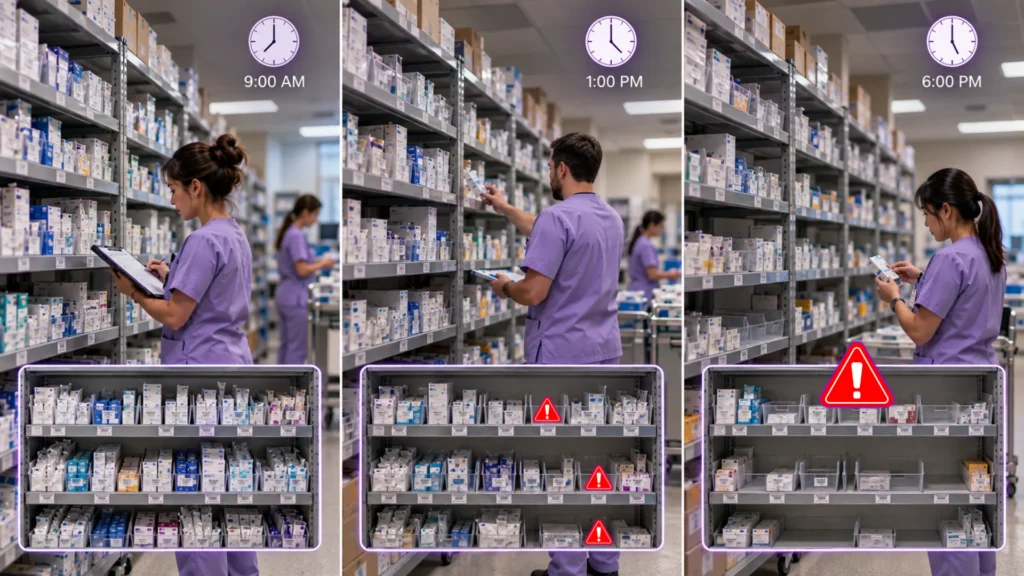
Hospital supply use is not always uniform. Demand may vary by day of the week, across months or with seasonal patterns. A single static setting can miss those shifts, especially when a room’s workload changes over time.
PAR Analytics includes usage forecasting based on daily, monthly and seasonal patterns. This gives teams another perspective when reviewing future needs. Instead of waiting for a recurring peak to cause a rush order, managers can examine whether the available history suggests a predictable change.
Forecasting remains an estimate. New services, unexpected events, supplier constraints and changes in clinical practice can alter demand. That is why the most useful approach combines data informed recommendations with regular review by people who understand the hospital’s operations.
Make PAR optimization an ongoing habit
The first set of recommended PAR levels is a starting point, not the finish line. As more usage information becomes available, teams can revisit their settings and see whether the original assumptions still hold. A room that changes its product mix or ordering routine may need a fresh review.
A practical review can be straightforward: identify items with repeated stockouts or excess inventory, look at recent order patterns, consider proposed minimum and maximum adjustments and agree on a small set of changes to assess. Documenting why a change was made helps the next review stay focused.
For supply chain leaders, the real advantage is consistency. Instead of relying entirely on individual memory or periodic guesswork, the team can use a repeatable method to set initial levels, evaluate recommendations and respond to changing demand. Better PAR decisions can support supply availability while keeping storage and replenishment work in view.
A practical example: two products, two different decisions
Consider a busy supply room with two very different products. One is ordered regularly and has experienced repeated shortages. The other is ordered less often but occupies several bins. A blanket instruction to increase or decrease inventory would treat both items alike, even though their needs differ. A data informed PAR review makes it possible to examine them separately.
For the frequently used item, the team might prioritise availability and review whether the minimum level or ordering frequency needs attention. For the slower-moving item, the team might examine whether its maximum level is higher than necessary. In both cases, available order history, room information and back testing provide context for the discussion.
The decision still belongs to the hospital team. Product criticality, supplier lead times and operational constraints should be considered alongside the recommendations. The point is not to let a model choose inventory levels in isolation, but to give people a stronger basis for deciding what to change and what to leave alone.
Explore PAR Analytics with Chooch
If your team is ready to move beyond estimated PAR levels, explore how Chooch PAR Analytics and Optimization can support more informed inventory settings and replenishment planning.